
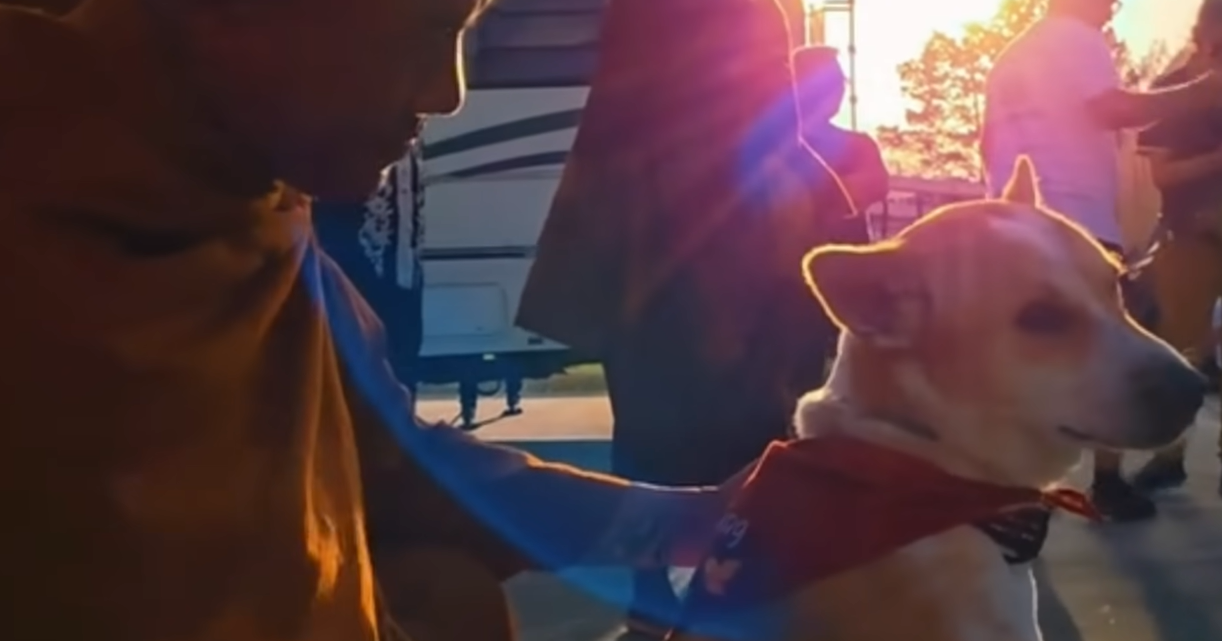

Aloka had no strategy when she arrived. Like most meaningful things, he arrived unexpectedly, unseen at first, but somehow clearly correct. Without hesitation or request, he started to follow a group of Buddhist monks in the midst of the densely populated rural area of India. A dog that used to look for food leftovers has discovered something more satisfying: a sense of belonging.
Not just any dog, but one with a heart-shaped symbol found naturally on his forehead, placed there like a symbol that nature has placed with care. Aloka kept pace with a calm intensity that many found very effective in capturing the spirit of the movement as the monks traveled silently over dusty roads and cacophonous crossroads. A stray had proven to be the most reliable representative of a walk intended to raise awareness of peace.
Aloka now walks throughout the United States, thousands of miles from where he began. He has traveled over farms, roads, tiny villages, and the fringes of cities from Fort Worth, Texas, to Washington, D.C., softly stepping next to the orange-robed figures who talk more silently than they do. So does he. Do not bark. Not on a leash. only being there.
His calm head, gentle eyes, and relaxed tail all have a way of making people stop what they’re doing. Videos of Aloka on the internet depict him either trotting ahead for a short time before turning around or stopping to sit close to kids. He occasionally wears a tiny cloth or robe on his back, which followers who have become devoted to his image have given him. He is now a fixture rather than just a follower.
Aloka The Peace Dog – Key Information
| Attribute | Details |
|---|---|
| Name | Aloka (The Peace Dog) |
| Breed | Believed to be Indian Pariah Dog |
| Estimated Age | Around 4 years old |
| Origin | Rescued as a stray dog in India |
| Distinctive Feature | Natural heart-shaped marking on his forehead |
| Current Journey | Walking 2,300 miles with Buddhist monks from Fort Worth to Washington DC |
| Role | Symbol of peace, compassion, and companionship |
| Viral Presence | Instagram: @alokathepeacedog with over 140K followers |
| Reference | People.com – Aloka Joins Monks’ Walk of Peace |
What is most poignant is the simplicity of his friendship. No orders or tricks are required. He knows the beat. He is aware of the speed. And he keeps going—without protest or complaint—even when the trip gets longer or the weather changes. The layout of this serene journey seemed to have been carefully planned for a dog that spent his early years avoiding hunger and traffic.
He now has over 140,000 followers on Instagram, and his page captures priceless moments: Aloka snuggled up under a Bodhi tree, Aloka nuzzled a youngster sitting barefoot in the grass, and Aloka waited at a crosswalk as monks sang behind him. The images are candid and unstaged. These are the kinds of images that stick with you rather than shouting.
A woman in Tennessee put a wool blanket on the ground at a rest area and pinned the words, “For the Peace Dog.” My heart is softened by you. It was hand-stitched and had the words “Continue, dear one” along with little lotus blossoms around the edge. Even though it was a simple moment, it made me realize how frequently we discover meaning via animals and how silently we long for it.
As I watched a little video of Aloka happily jumping toward a puddle before he returned to his spot next to the monks, I gave that some thought. He made up his mind to go back without delay. Just motion, awareness, and then coming back. It occurred to me that the concept of peace might resemble that.
Aloka and his companions have made a very inventive contribution by discreetly traversing states and pausing at temples, churches, shelters, and schools. This is a nonverbal call to slow down. They’re not preaching or demonstrating. They are walking in a straightforward and real manner, with one small dog serving as a focal point. That strategy has been very effective at establishing resonance in a culture that is distracted.
Aloka’s journey serves as a reminder of the subtle qualities we frequently take for granted, such as patience, kindness, and constancy, in an era of shattered communication and hastened judgment. He continued walking when he could have strayed again, making him a stray who is now celebrated. Because he stayed voluntarily rather than out of duty.
Other than expressing gratitude, the monks have not discussed Aloka’s participation. They don’t assert that they own him. All they say about him is “the companion.” The walk has been markedly consistent in that humility. There is no one asserting leadership. Nobody is asking for credit. And maybe that’s why the message has such a profound effect on people who see it.
He has received food, paw balm, and even handmade boots from supporters along the way to protect him from the hard ground. As reminders that nurturing can be unplanned, straightforward, and inclusive, these acts of care are incredibly human and are not performative. To repay such kindness, he doesn’t need words. His mere presence is sufficient.
Although attention now follows him, Aloka does not want attention. His journey is now a phenomenon that is softly spoken. Essays on him are being given out by schools. Sketches of him are being made by artists. Although he has been likened to therapy dogs, his influence is even more subdued—more about setting an example of silent resiliency than it is about alleviating pain.
The route he has taken is more significant than whether he makes it to Washington, D.C. in addition to quiet. By being nice. And with a kind of faith that has proven remarkably resilient, despite being brittle in its early manifestations.
