
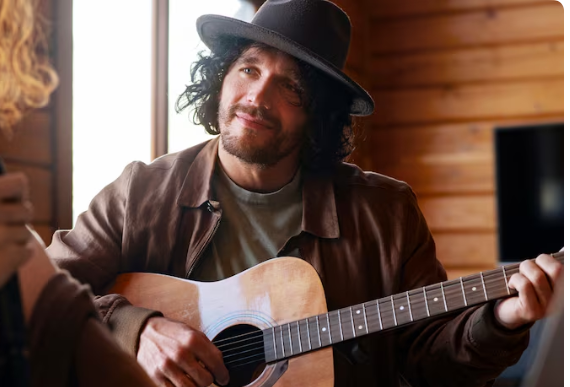

For years, Lee Brice has been perfecting a craft that used to entail avoiding the spotlight. His music—which is frequently soulful and sometimes rough—leans into tales that are rooted in tenderness and resiliency and feel especially American. However, Brice’s action in early 2025 drew him into a much louder discourse that was full of flashing headlines, cultural differences, and a moment that few others in the country music industry appeared prepared to claim.
The branding wasn’t subtle when conservative activist group Turning Point USA said it would conduct a “All-American Halftime Show” during the Super Bowl. It was promoted as a traditional, patriotic, and purposefully anti-official NFL performance that included Puerto Rican superstar Bad Bunny. Brice was chosen to be the event’s main act, despite the fact that his catalog had not been very political. And as soon as he took the stage, his alignment became active rather than implicit.
| Name | Lee Brice |
|---|---|
| Born | June 10, 1979, Sumter, South Carolina |
| Profession | Country music singer-songwriter |
| Notable Hits | “I Don’t Dance”, “Hard to Love”, “Love Like Crazy” |
| Affiliations | Curb Records, performed at Turning Point USA’s halftime show |
| Controversy | Criticism over participation in MAGA-aligned event and song lyric |
| External Link |
The next day, Brice posted a video of the performance to Instagram with the casual statement, “It ain’t easy being country in this country nowadays.” It was a phrase from his recently released song. However, they landed with a cultural sledgehammer’s weight. What might have begun as an artist’s lament swiftly turned into a referendum on protest, privilege, and the cost of voicing your opinions.
The responses were quick and polarized. Many devoted followers appeared in disbelief in the comments section. Some were disappointed, while others were perplexed. Some made an effort to be kind, asking Brice to consider the meaning of his lyrics more carefully. “Nobody is asking you not to be country,” one admirer said. Both Bad Bunny and you are Americans. Another, more direct, wrote: “You might be contributing to the issue, sir.”
Many people were aware of the irony in Brice’s statement. Some listeners found the notion that it’s “not easy being country” to be remarkably out of touch in a nation where country music still dominates radio charts, award programs, and entire regional economies. “Being Black or Brown in this country is not easy,” one commenter said bluntly in response. Coming from a famous and privileged white man, that is an outrageous remark.
Nevertheless, Brice’s sharing was not wholly new. Many artists who grew up in traditional neighborhoods or with strong ties to rural customs may subtly internalize the sense of alienation in a fast changing cultural landscape. It occasionally appears in a lyric. Occasionally, when selecting a location. It appeared in both in this instance.
The halftime performance by Turning Point was presented as a celebration of “traditional American values.” However, when put into practice, it turned into a form of cultural counterprogramming that distinguished between what is and is not “American.” Conservative opposition was directed at Bad Bunny because of his all-Spanish performances and emphasis on a Puerto Rican identity. Former President Trump even voiced his opinion, referring to the performance as “anti-American.”
Brice’s show, on the other hand, heavily included sing-along anthems, cowboy hats, and flag-waving patriotism. That might have been sufficient for his main audience. However, it appeared purposefully exclusive to the larger audience that was listening. And the focal point was Brice’s lyric, which was sung casually yet with great care.
An intriguing tension exists here. Numerous elements have always been present in country music. It’s a genre that frequently defies simple assumptions, as evidenced by Dolly Parton’s subdued charity and Johnny Cash’s prison concerts. However, in recent years, country musicians have been urged to take a side, whether rightly or wrongly, as the political landscape has become more polarized and online audiences have divided into opposing ideologies.
This specific instance is noteworthy because Brice shared a lyric rather than a lecture or screed. And that’s where the force of music both makes aim clear and makes it more difficult to understand. Lyrics have the power to exclude as well as to comfort. In Brice’s instance, his statement appeared to strike a deep chord with certain followers while alienating others, causing a gap that might be readily healed with a few harmonious notes.
However, it wasn’t a coincidence that Brice chose to play with Turning Point and spread that line. It was a decision. And that decision was significant at a time when cultural branding is frequently just as important as vocal performance. Some artists welcome controversy. Others fall into it by accident. But nobody enters an event like this knowing what it means, especially not someone as well-known as Brice.
The reaction also demonstrates the extent of audience change. Fans are now active players rather than merely passive listeners. They anticipate that their favorite artists will either share their ideals or at the very least take into account their wider influence. Brice faced criticism that was partly contextual in nature as well as political. Regarding time. Regarding what his voice, which was connected to that stage, indicated.
However, there is cause for hope in all of this. Music is still a very flexible conversational tool. It’s possible that Brice needs to deepen the conversation rather than retreat from it. Songs can be changed. It is possible to clarify messages. And artists can learn from criticism as well as praise, just like the rest of us.
