
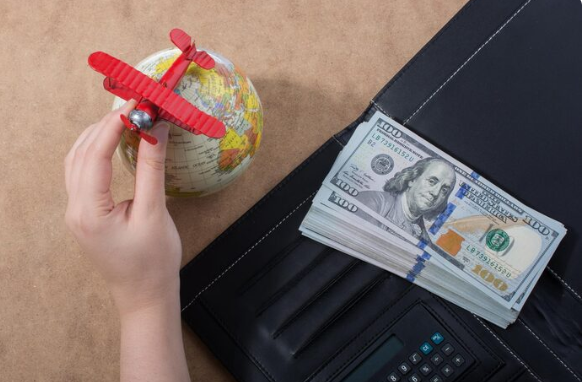

Intriguingly, Americans are paying more money every time they choose to pack a bag, while taking fewer flights these days. It’s a strategic realignment that represents a consumer mindset sharpened by inflation, financial prudence, and a sophisticated sense of what is worthwhile, not only a short-term fix.
Even a brief journey is still a journey. The general agreement seems to be that. Almost one-third of those polled are opting for shorter itineraries, and almost as many have begun substituting road trips for flights. Many are transforming travel into something more purposeful rather than doing away with it completely. They’re extracting more value from fewer days with remarkable efficiency.
Key Patterns in American Travel Spending Behavior
| Category | Key Insight |
|---|---|
| Flight Frequency | Many Americans are flying less often, choosing fewer trips per year |
| Per-Trip Spending | Per-trip costs are rising, with travelers allocating more to select items |
| Dining Expenditures | Restaurant spending has increased significantly, especially post-pandemic |
| Lodging and Airfare Trends | Spending remains soft due to cost sensitivities, especially in main cabins |
| Travel Planning Strategy | Consumers are opting for direct bookings, off-peak travel, and alternatives |
| Travel Sentiment | 92% still plan to travel despite 81% expressing financial concerns |
| Spending Preference Shift | Dining out and short meaningful trips prioritized over luxury accommodations |
| Sources |
Meanwhile, spending at restaurants is increasing. American Express said that its cardholders’ dining expenditures increased by 8% per quarter. As of June, Bank of America reported a 2.1% increase in restaurant transactions year over year, reinforcing that pattern. These numbers don’t point to a decline in enjoyment. They show a deliberate choice to forgo quantity in favor of experience. It’s a joyful investment.
Travelers are spending more on the things that create memories, such as late-night beverages in memorable locations or dinners shared on balconies, while forgoing suite improvements and restricting discretionary extras. The reasoning is somewhat similar to how someone could forgo their second cup of coffee in order to spend more money on a nicer bottle of wine on a Friday evening. It’s about something more meaningful, not less.
Even though they are still substantial, airfare and hotel expenses have not kept up. Several airlines have reported that the main cabin portion is noticeably softer. Flyers that care about price are either driving or skipping this one. It’s interesting to note that this change is pushing some airlines to give priority to premium seating—not by mistake, but by deliberate design. People may simply try to travel better when they travel less frequently.
Local economies, hospitality marketing, and loyalty programs are all impacted by this dynamic. This reallocation is helping restaurants, especially in tourist-heavy areas. Discretionary spending, according to some industry observers, is moving in new directions. It’s rerouting, not disappearing.
Only a portion of the tale is revealed by the numbers. Anecdotally, a pattern emerges from chats at rest areas along highways or airports. Intentions are spoken more often than destinations. During a flight from Dallas, a father informed me that he was taking his daughter “just to have one good trip this year.” I was struck by that framing—not just excellent, but one good trip.
It seems like every journey now has greater significance. And that weight results in richer but fewer options. Thousands of Americans are quietly rewriting a playbook that includes booking during shoulder seasons, selecting Airbnb over expensive resorts, and choosing less well-known places where prices are lower.
At a nearby café, I recently saw a couple using a spreadsheet to organize their summer. Neither “Paris” nor “Mexico” were the labels on their tabs. They were called “Food,” “Value,” and “Vibe.” It had a startlingly futuristic vibe, as if travel had transcended destinations and instead focused on the present.
The way this recalibration is reflected in credit card data is remarkable. Despite a decline in the frequency of travel, overall spending has reached unprecedented heights in many areas. When bank executives discuss “consumer resilience,” they are actually talking about consumer selectivity. People are being increasingly picky about when and how they spend their money due to price increases, which is making the travel industry noticeably more targeted.
This choice has a greater effect on households with lower incomes. Instead of completely abandoning travel, they are making adjustments to guarantee participation without placing an excessive load on people. This could entail selecting locations with inherent cost or making reservations with no change fees. Even though circumstances limit these choices, they are nevertheless very aspirational.
On a larger scale, the change indicates that the travel industry is becoming more experience-driven. Airlines are changing. Hotels are adapting. Cities are starting to present themselves in a different way, becoming more approachable and genuine. Those who react quickly will probably succeed.
This trend’s psychology is based on a balance between caution and hope. Economic pressures are still present, so proceed with caution. optimism due to the persistent belief that travel is valuable enough to warrant protection. Worth reshaping, too.
Customers are changing their preferences in a way that feels both purposeful and emotionally based, rather than only responding to price changes. They are “budgeting for joy,” to use a behavioral economics term.
We are living through a reset that is neither depressing nor backward. Instead, it’s a move toward intentionality—toward planning journeys that seem unique, justified, and incredibly valuable. The message is always the same, whether it’s a single cross-country flight scheduled months in advance or a brief getaway to a neighboring beach: less noise, more meaning.
Although Americans may be taking fewer flights, they are doing it more intelligently, which is changing our perception of the worth of travel in general.
