
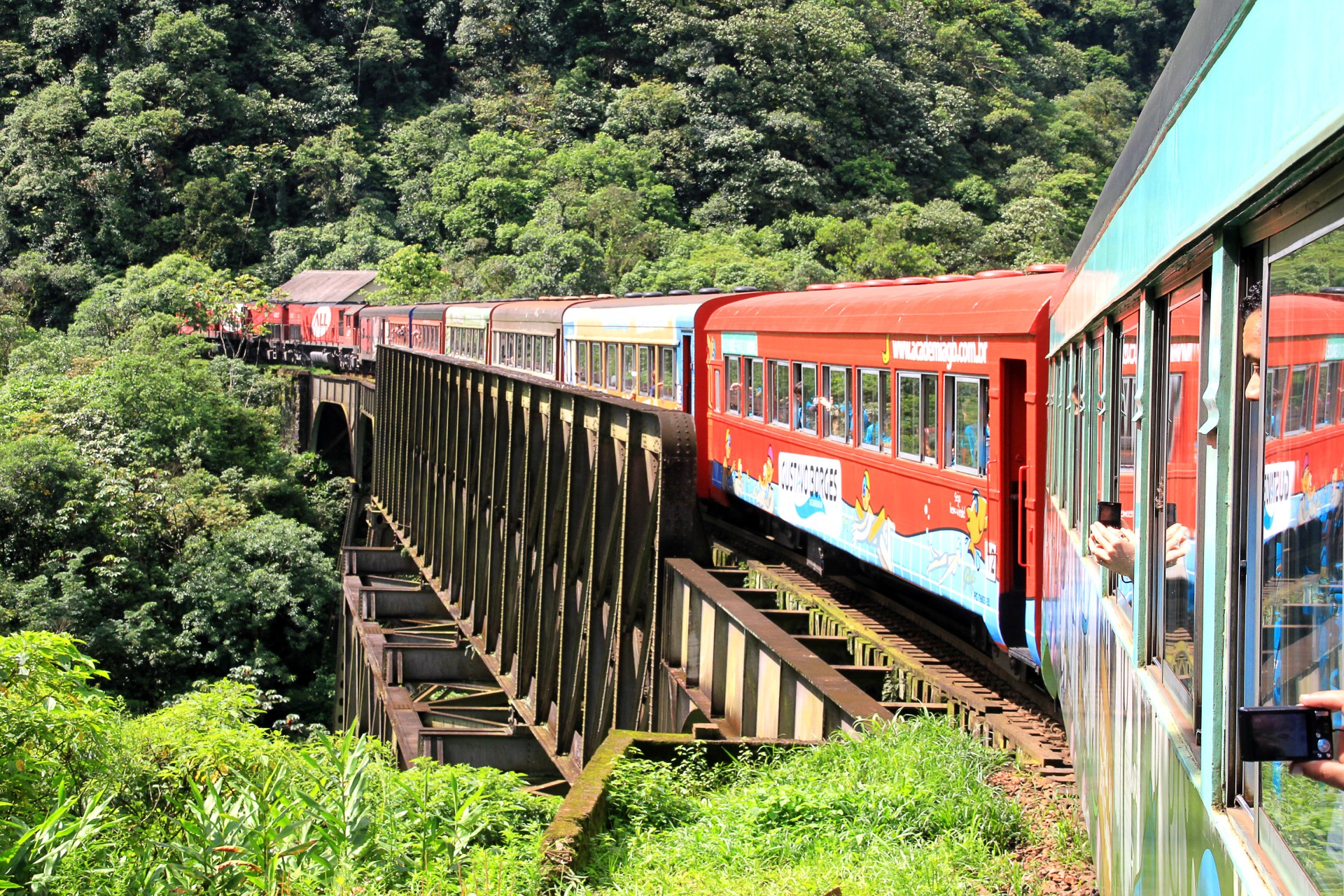

Almost 280,000 passengers rode the Serra Verde Express in 2025 alone, many of them oblivious to the railway’s explosive origins. The line connecting Curitiba to Paraná’s coast was designed by the Rebouças brothers—sons of a self-taught engineer, grandsons of a freed enslaved woman—who insisted on one controversial condition.
No enslaved labour. Not unless paid.
That demand, made directly to Emperor Dom Pedro II in 1880, set the railway apart during Brazil’s slavery era. Yet the engineering itself proved even more audacious: 41 bridges spanning Atlantic Rainforest canyons, 13 tunnels bored through mountain rock, and a highest point reaching 952 metres above sea level. The São João bridge alone stands 113 metres tall—equivalent to a 37-storey building suspended over dense forest.
Today, Serra Verde Express operates 25 carriages along the 70-kilometre route, maintaining a maximum speed of 30 kilometres per hour. The four-hour crawl isn’t a limitation. It’s the point.
Passengers in the Boutique class receive unlimited beer, juice, and soft drinks alongside curated snacks, whilst the premium Litorina railcars—self-propelled units with open balconies—offer unobstructed views of one of Brazil’s best-preserved stretches of Atlantic Rainforest. Some carriages lean into vintage décor; others prioritise modern accessibility. The Bove Car welcomes pets. The Carmen Silva Car accommodates wheelchair users.
Last summer alone, more than 70,000 people made the journey to Morretes or returned to Curitiba by rail. The BBC’s Celebrity Race Across the World featured the line in 2024, and bookings surged. Over nearly three decades of operation under Serra Verde Express, the route has carried more than 4 million passengers.
The railway terminates in Morretes, a coastal town founded by Jesuits in 1733. Cobbled streets preserve colonial architecture. The town square bustles with handicraft vendors. And every restaurant serves Barreado—a slow-cooked beef stew prepared in clay pots, seasoned with spices, then served with cassava flour and bananas. The dish harks back to tropeiros, colonial muleteers who needed meals that could simmer for hours whilst they worked.
Yet the railway nearly didn’t reach Morretes at all.
In 1865, André Pinto Rebouças studied a map and noticed that Antonina—another coastal settlement—aligned almost perfectly with Asunción, Paraguay. He pitched his father and brother on building a transport route linking the cities, envisioning efficient cargo movement. Then the Paraguayan War erupted, and the plan stalled.
Six years later, yerba mate barons in Curitiba grew desperate. Uruguay, Chile, England, and France were consuming vast quantities of the herb, but Paraná had no proper roads to the coast—only indigenous trails navigable by mule trains. In 1873, André’s brother Antonio Pereira Rebouças Filho presented the Dona Isabel Railway project to Paraná’s provincial president, reviving André’s earlier proposal.
Antonio died of malaria in 1874. The project passed to Irineu Evangelista de Souza, the Baron of Mauá, who had pioneered Brazilian railways.
Then politics intervened. Antonina and Paranaguá—rival coastal towns—both claimed the right to host the railway’s terminus. In 1875, the imperial government sided with Paranaguá. Four years later, a Belgian-French company called Compagnie Générale de Chemins de Fer Brésiliens secured the concession, appointing engineer Antonio Ferrucci as general director.
On June 5th, 1880, Emperor Dom Pedro II laid the cornerstone in Paranaguá. Construction took five years. The Rebouças brothers’ insistence on avoiding unpaid enslaved labour—remarkable for the era—shaped hiring practices throughout. On February 2nd, 1885, the railway opened.
It remains a benchmark of Brazilian engineering, celebrated not just for its ambition but for the fact that national engineers executed the entire project.
The trains now accommodate up to 1,200 passengers, though capacity varies with demand. Tourist class offers the most affordable entry point. Boutique and Litorina carriages cater to those willing to pay for themed interiors and open-air viewing platforms. All three classes traverse the same dramatic route—the same bridges, tunnels, and gradients that challenged engineers 140 years ago.
Whether the 280,000 passengers who rode the line this year knew the Rebouças story is unclear. Most come for the waterfalls, the century-old bridges, and the chance to photograph mist clinging to canyon walls. But the railway’s history shadows every kilometre: a testament to what marginalised engineers achieved when an empire—reluctantly—gave them the chance.
