
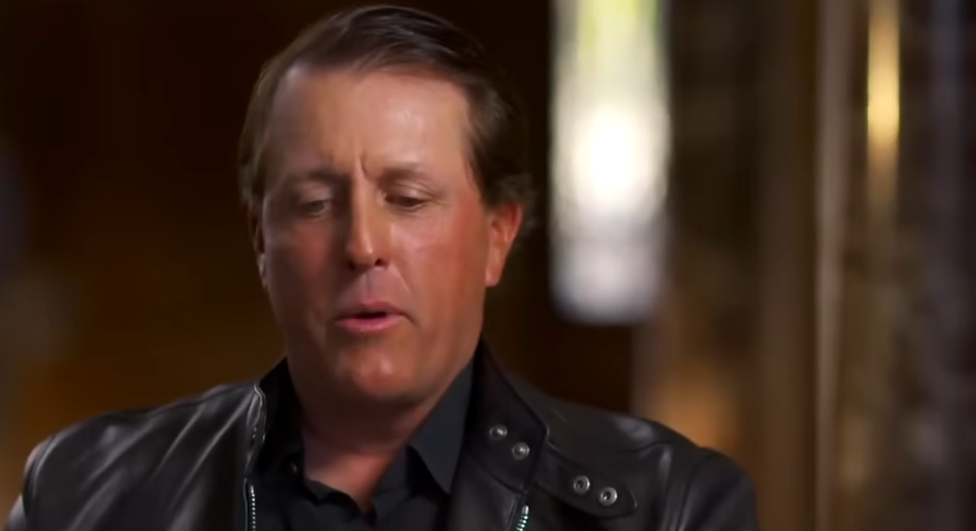

There is an odd silence in the air at Augusta National late in the afternoon. A golf ball clicks sharply against a clubface somewhere in the distance, the galleries murmur, and the pine trees hardly move. Phil Mickelson has spent decades living in that environment. There has always been a feeling that he likes taking risks more than most golfers, especially when you watch him walk down a fairway with his head slightly tilted and his eyes calculating angles most players wouldn’t try.
His career and wealth have been shaped by that mindset. Phil Mickelson’s net worth, according to current estimates, is approximately $300 million. It was amassed through tournament wins, endorsement deals, and one contentious choice that altered the financial landscape of professional golf.
| Category | Details |
|---|---|
| Full Name | Philip Alfred Mickelson |
| Nickname | Lefty |
| Date of Birth | June 16, 1970 |
| Birthplace | San Diego, California, USA |
| Profession | Professional Golfer |
| Major Championships | 6 |
| PGA Tour Wins | 45 |
| Estimated Net Worth | Around $300 million |
| Career Earnings | Over $1 billion (including endorsements) |
| Current Tour | LIV Golf League |
| Reference | https://www.celebritynetworth.com |
Born in 1970 in San Diego, Mickelson grew up in a home where playing golf was practically a family ritual rather than just a pastime. He spent long afternoons practicing with his father, an airline pilot. Mickelson is naturally right-handed, but he mimics his father’s mirrored motion by swinging the club left-handed. This is an intriguing detail that continues to captivate golf enthusiasts.
He developed the unique style that eventually earned him the moniker “Lefty” by imitating every move while standing on a driving range as a child.
He soon rose to prominence as one of the country’s top amateur golfers at Arizona State University. They went on to win three NCAA titles and the Haskins Award three times in a row. It was evident from watching those early competitions in the late 1980s that Mickelson had a unique talent—an innate inventiveness on the golf course that is difficult for coaches to impart.
Mickelson was referred to as the “best player never to win a major” for many years while playing on the PGA Tour. Everywhere he went, the statistic followed. By 2003, he had consistently placed close to the top of major competitions, putting on outstanding performances but never sealing the deal. Many golf enthusiasts can still recall this particular moment.
Mickelson faced an 18-foot birdie putt on the 18th green at Augusta National during the 2004 Masters. He leaped into the air with his arms raised and a look of disbelief on his face as the ball fell into the cup. It was no longer a drought.
Everything changed after that victory. The majors became more frequent after that: the PGA Championship in 2005, another Masters title in 2006, a third Masters victory in 2010, the Open Championship in 2013, and—possibly most impressively—the PGA Championship in 2021, where he became the oldest golfer to win a major.
It was almost cinematic to watch that last round at Kiawah Island. As he made his way to the last green, fans lined the fairways, some of them running alongside him. It felt more like a celebration of longevity than a typical tournament conclusion. Mickelson’s financial empire had already expanded significantly by that point.
His winnings from tournaments alone have surpassed $100 million, making him one of the wealthiest golfers in history. However, endorsements were the true source of wealth. Businesses like Callaway, Rolex, Ford, KPMG, and Amgen made significant investments in his public persona.
Mickelson reportedly made between $80 million and $100 million a year in certain years, mostly from sponsorships rather than prize money. After all, personality is rewarded in golf nearly as much as skill.
Furthermore, Mickelson has always had personality. He exuded a slightly erratic aura due to his daring shots, quick smile, and sporadic gambling rumors. Even when it resulted in errors, fans appeared drawn to that unpredictability. Nevertheless, 2022 saw the most significant financial turn of events.
That year, Mickelson signed a reported $200 million contract to join the Saudi-backed LIV Golf League. The action provoked heated discussion in the sports community. A few golfers declined to sign up for the new tour. Mickelson’s example was followed by others.
During one of those early LIV events, I stood on the practice range and noticed an odd atmosphere that was a combination of exhibition and rebellion against the conventional structure of golf.
That choice might have permanently changed the landscape of professional golf. It’s unclear if fans approve or not.
These changes are reflected in Mickelson’s wealth. Including contracts, endorsements, and prize money, his career earnings are estimated to have exceeded $1 billion. The sum has been increased by business endeavors, golf course ownership, and real estate investments.
Even so, wealth doesn’t seem to be the main focus when watching him play these days.
The risky flop shots, the audacious approach angles, and the feeling that Mickelson would prefer to fail spectacularly than win safely are all still part of his aggressive style. He has previously lost tournaments due to that mindset. Additionally, it has produced some of the most iconic moments in contemporary golf.
It’s difficult to ignore how peculiar his career has been. Few athletes continue to compete for over thirty years. Even fewer are able to convert that longevity into hundreds of millions of dollars while still igniting discussion about their sport’s future.
It’s unclear if Phil Mickelson will finish his career as a rebel, a hero, or something in between. However, the balance sheet reveals one indisputable fact while standing on a peaceful golf course somewhere, maybe in Florida or Arizona.
By following his instincts, the young man who once imitated his father’s swing in a backyard practice area went on to amass a $300 million fortune.
