
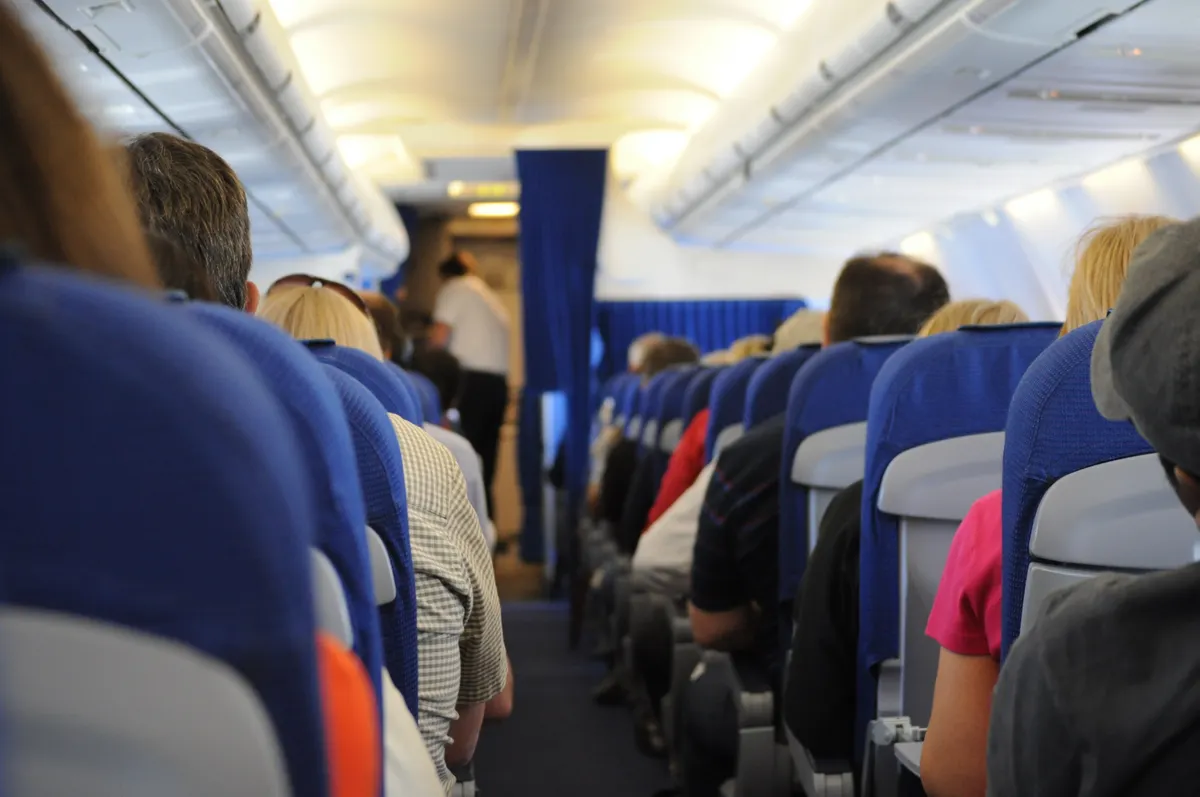

A China Eastern power bank fire broke out inside an overhead baggage compartment on Flight MU2421 on 24 July 2026, shortly after the aircraft arrived at Guiyang Longdongbao International Airport following a domestic service from Lanzhou. Cabin crew extinguished the flames before passengers disembarked, and no injuries were reported.
Video circulated on social media shows flames and smoke emerging from an open overhead bin on what was reported to be an Airbus A320. A flight attendant can be seen reaching into the compartment as crew worked to bring the fire under control. Airport firefighters also responded to the aircraft, which sustained minor smoke damage, according to the Aviation Safety Network.
One passenger told Chinese media that travellers near the front of the cabin began shouting and moving toward the rear once the fire was discovered. ‘I thought the outside of the plane was on fire, but when I looked up, I saw flames coming out of the overhead luggage rack,’ the passenger said, in a report cited by The Sun. A second passenger said crew remained calm throughout, instructing travellers not to panic.
China Eastern power bank fire exposes a clear rule breach
China Eastern permits power banks in carry-on baggage only, but its published safety rules explicitly prohibit passengers from placing power banks or spare lithium batteries in overhead bins. Passengers are also banned from using power banks to charge devices during flight. The device that ignited on MU2421 was stored inside a passenger’s carry-on bag in the overhead compartment, in direct contravention of those rules.
Lithium-ion batteries can enter thermal runaway when damaged, defective or exposed to excessive heat. The reaction produces intense heat, smoke and flames, and may continue even after a visible fire has initially been suppressed. Regulators globally require spare lithium batteries and power banks to remain in the passenger cabin rather than in checked baggage, precisely so crew can respond quickly when ignition occurs.
CAAC tightens enforcement across 238 airports
China had already moved to close regulatory gaps before this incident. The Civil Aviation Administration of China (CAAC) introduced stricter rules for power banks on domestic flights in June 2025, banning devices without China Compulsory Certification markings, known as 3C, as well as recalled models and items with unclear certification labels.
According to China Discovery, the CAAC has strictly enforced those rules since 28 June 2025, prohibiting any power bank without a visible CCC mark from all domestic flights. The same rules set capacity thresholds: power banks under 100Wh may be carried on without prior approval, those between 100Wh and 160Wh require airline permission, and anything above 160Wh is banned entirely.
The enforcement reach is broad. Flight Delayed reports that all 238 civil airports in China now have dedicated inspection points where security officers physically check power banks for CCC certification before passengers board. The scale of that infrastructure underlines how seriously Chinese aviation authorities are treating the lithium battery risk.
A pattern of overhead-bin incidents
The Guiyang incident is the latest in a series of power bank fires on aircraft in the region. In March 2025, a power bank fire in an overhead compartment forced a Hong Kong Airlines Airbus A320 operating from Hangzhou to Hong Kong to divert to Fuzhou. All 168 passengers and crew escaped without injury.
In January 2025, an Air Busan Airbus A321 was destroyed by fire at Gimhae International Airport in South Korea while preparing to depart for Hong Kong. Investigators identified a power bank stored in an overhead bin as a possible source of that fire. The Air Busan case, in particular, prompted fresh scrutiny of how carriers and airports enforce carry-on battery rules.
The CAAC’s enhanced inspection regime, now operational across the entire Chinese domestic network, represents the most systematic industry response to date. Whether the passenger on MU2421 was carrying a non-compliant device or simply ignored the overhead-bin prohibition will be a matter for the airline’s own investigation, the outcome of which China Eastern has not yet disclosed.
