
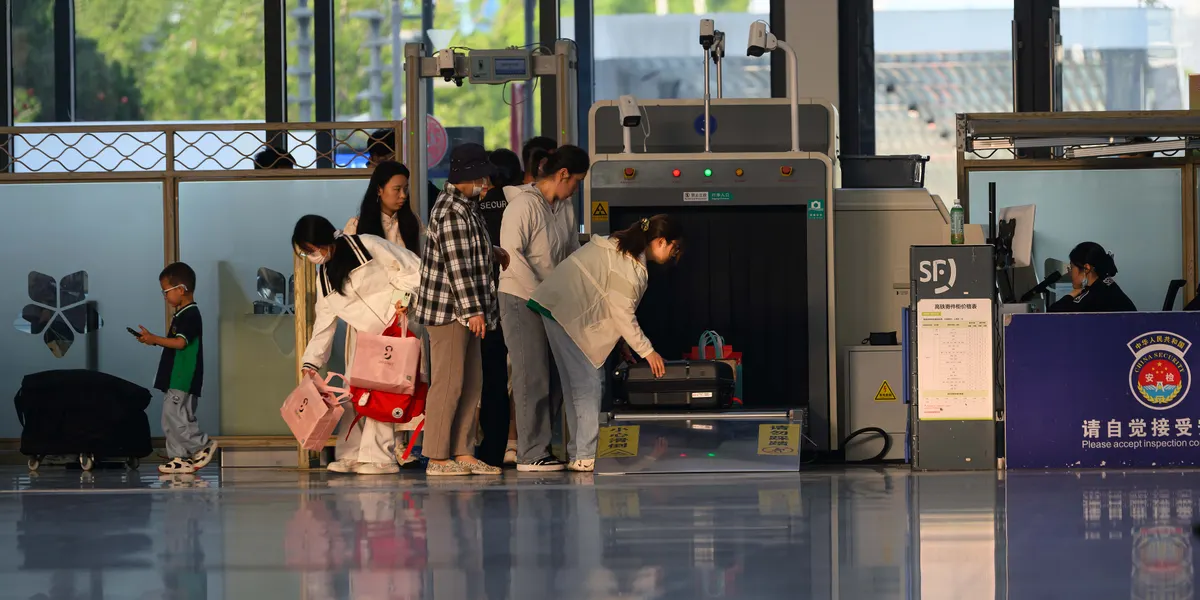

A covert operation involving ICE TSA airport arrests is drawing scrutiny across the US aviation network, after footage of a woman being led off a jetway at Denver International Airport went viral and a concurrent arrest at San Francisco International Airport emerged in the same week.
The Denver arrest, which took place on 20 July 2026, involved Chantal Alejandra Morales Rojas, who was detained by plainclothes ICE officers on the jetway as she prepared to board a Southwest Airlines flight. The Department of Homeland Security (DHS) confirmed the arrest, stating that Morales Rojas, from Ecuador and resident in Oakland, had entered the US on 20 October 2024 on a visa permitting her to remain until 4 January 2025. ‘In violation of our nation’s laws, she overstayed her visa,’ DHS said in a statement. Morales Rojas remains in ICE custody pending removal proceedings. The Denver Post reported she was 27 at the time of her arrest.
How ICE TSA Airport Arrests Are Being Carried Out
The operation bypasses the warrant and surveillance infrastructure traditionally associated with immigration enforcement. According to American Community Media, the Transportation Security Administration (TSA) is sharing traveller information directly with ICE, giving the agency real-time access to passenger data at check-in counters and gates. A source quoted in the original report described the mechanism plainly: ‘There is no investigation or no home visit involved. It’s simply a name match at a checkpoint, and that’s what makes this approach so efficient for ICE and so unsettling for travelers.’
Southwest Airlines, whose flight Morales Rojas was boarding, confirmed it complies with applicable law when asked to share customer information. ‘The airline has provided guidance to Employees to help ensure appropriate legal documentation is presented by law enforcement agencies prior to interactions in the gate areas,’ the carrier said in a statement. The airline added that it is ‘committed to providing a safe travel experience for all Customers and Employees.’
The Denver case was not isolated. ABC7 San Francisco reported that during the same week as the Morales Rojas arrest, ICE carried out a separate detention at San Francisco International Airport (SFO) involving a Ukrainian woman. The concurrent nature of the two incidents points to a broader, co-ordinated enforcement posture at major US airports rather than isolated operations.
A GoFundMe established to cover Morales Rojas’s legal costs described her as having spent two years working as an au pair. An update posted on 25 July reported that she had ‘secured an excellent immigration lawyer who filed a habeas petition’, a legal mechanism allowing those in detention to challenge their confinement before a court.
Guidance Issued for Travellers at Risk of ICE TSA Airport Arrests
The National Immigration Law Center (NILC), a non-profit that defends the rights of low-income immigrants, issued a community alert in December flagging the risk of airport enforcement activity. The NILC identified six circumstances that raise a traveller’s exposure: outstanding deportation orders; legal status the government has revoked or intends to revoke; pending immigration applications; any criminal history for non-US citizens; holding a green card; and holding Deferred Action for Childhood Arrivals (DACA) status or similar deferred-action arrangements.
The NILC advised affected travellers to carry proof of lawful status and to memorise the contact numbers of a lawyer or a trusted person available on call. The organisation also recommended steps to limit the risk of device searches, including travelling with printed boarding passes rather than digital ones.
The American Civil Liberties Union (ACLU) has separately published guidance covering scenarios immigrants could encounter at airports, ranging from fingerprinting to strip searches.
The scope of ICE TSA airport arrests across the national network remains unclear. DHS and TSA had not responded to media requests in time for publication of the original report, leaving open questions about the formal legal basis and scale of the co-ordinated checkpoint programme. For travel-industry operators, the operational reality is already visible in gate areas: plainclothes officers are conducting enforcement at the point of departure, with airlines now fielding formal guidance requests from their own staff on how to handle law-enforcement interactions before boarding.
