
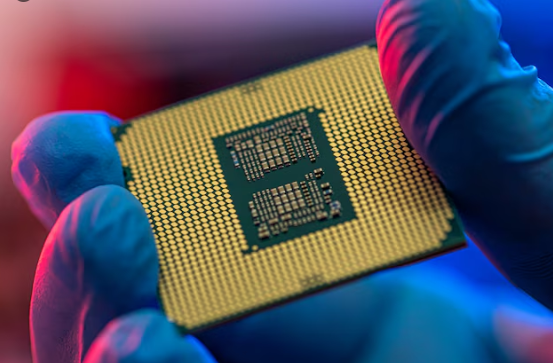

Apple Park’s glass panels reflect a sky so clear it nearly looks staged on a sweltering afternoon in Cupertino. Engineers have been working on what appears to be an unseen object—a chip—inside the circular building for years.
Going back to the hum of previous MacBooks, with their buzzing fans and the warmth that spreads across aluminum laps during video conversations, will help you comprehend why Apple is permanently abandoning Intel. It’s difficult to ignore how frequently Macs with Intel processors tended to run hot, occasionally making more noise than the environment they were in. Apple allowed it to continue for years. Then it didn’t.
| Category | Details |
|---|---|
| Company | Apple |
| Former Chip Partner | Intel |
| Manufacturing Partner | TSMC |
| Current Chip Generation | Apple M4 (ARM-based custom silicon) |
| Transition Began | 2020 (Apple Silicon announcement) |
| Reference | https://www.apple.com/newsroom/ |
It became challenging to overlook Intel’s manufacturing delays. Transitions to smaller, more effective process nodes did not proceed as planned. In the meantime, TSMC, the massive Taiwanese manufacturing company that makes Apple’s bespoke silicon, was rapidly advancing into the 5-nanometer and beyond. The silent parameter that counts most in laptops, performance-per-watt, started to move significantly against Intel. It seems like Apple wanted more than just improved CPUs. It desired authority.
With the launch of Apple Silicon in 2020, the change was made public. The M1 astounded reviewers. The battery’s lifespan doubled. Heat escaped almost inexplicably. In certain instances, the fans completely vanished. After years of designing around thermal limits, engineers were suddenly forced to develop without them. The M4 seems more of a statement than an improvement.
The M4’s development in Apple’s labs apparently prioritized integration over raw performance, with a closer match between machine learning cores, macOS, hardware, and battery efficiency. Apple’s ARM-based architecture creates a sort of architectural symmetry across devices by enabling the same design concept to be applied to the iPhone, iPad, and Mac. This unity might be more significant than any one benchmark result.
Apple was bound by someone else’s roadmap under Intel. In California, chip delays in Arizona or Oregon turned into product delays. Battery compromises, louder fans, and thicker machines were the results of thermal inefficiency. Apple’s fixation on silence and thinness clashed with uncontrollable silicon reality. Apple matched its own timetable with its own destiny by switching to its own chips, which are made by TSMC.
The difference is small but noticeable when you walk into an Apple Store today. MacBooks open up immediately. They maintain their composure after working long hours. Without looking for plugs, creative professionals use battery power to edit 4K footage. Dramatic marketing moments are not what these are. These are more subdued enhancements that gradually foster loyalty.
This vertical integration appears to be strategic insulation in the eyes of investors. Controlling silicon preserves profitability and lessens reliance on outside sources. Additionally, it enables Apple to prioritize use cases without waiting for a third party to do so, such as AI acceleration or video rendering.
According to reports, the M4 uses sophisticated manufacturing techniques that Intel found difficult to match in order to further increase efficiency. Apple doesn’t seem eager in resuming that collaboration, despite Intel’s efforts to make a resurgence with its foundry approach. It seems like this divorce will go forever.
The action is culturally reminiscent of Apple’s past. Performance survival was the reason behind Steve Jobs’ 2005 switch from PowerPC to Intel for the Mac. It feels strange to be at Apple Silicon now. It has to do with independence. a long-term plan to guarantee that the services, Mac, iPad, and iPhone all develop together.
That harmony is easy to sense but hard to measure. AirDrop functions flawlessly. Device boundaries are blurred by Universal Control. Macs can run iPhone apps natively. In the absence of architectural alignment, none of this would be as seamless.
However, the risk was not insignificant. It is not easy to design high-performance desktop-class chips. R&D costs billions, and iteration is constant. The Mac might have suffered if Apple had made a mistake.
In terms of performance-per-watt, Apple’s silicon now equals or exceeds rivals, changing the standards for laptops. In response, rivals have accelerated their own designs based on ARM. It has an impact on the entire PC business.
How far Apple will take this approach is yet unknown. Will high-end desktops be dominated by M-series chips? To what extent will Apple embrace on-device AI workloads? The M4 conveys both patience and ambition.
The afternoon light softens against the curved glass outside Apple Park. With laptops that no longer roar under pressure, engineers go in silence. It is no longer a move from Intel to Apple Silicon. The new normal is this. And you can hear the sound of control being regained in that silent hum—or lack thereof.
