
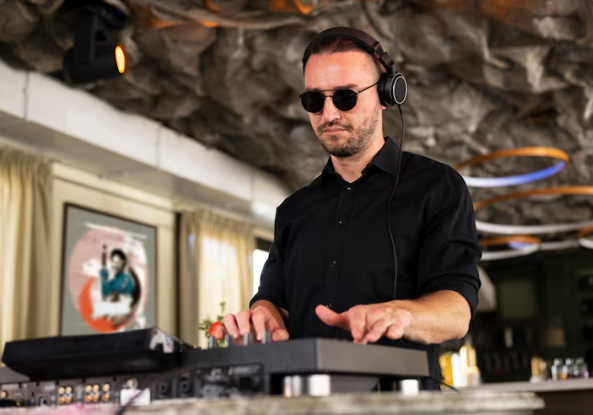

It was easy to believe him when he claimed that the business side of music was equally as exciting as the stage rush. Throughout his career, Steve Angello has been a crowd-mover and a deal-closer. His estimated net worth of $40 million is remarkably stable, which can be explained by that combination, which has been maintained over more than 20 years.
Born to a Greek father and raised in Sweden, Angello’s heritage is rooted in two different cultural frequencies: an entrepreneurial spirit and a musical experimentation. Hip-hop turntablism was his first musical passion, but he found himself drawn to house music like a magnet. Angello rarely viewed fame as a destination, even though by his early twenties he was remixing songs that were already popular on European radio. It seemed more like a necessary halt on a longer journey to him.
Steve Angello Key Facts
| Detail | Information |
|---|---|
| Full Name | Steve Patrik Angello Josefsson Fragogiannis |
| Stage Name | Steve Angello |
| Born | November 22, 1982 |
| Nationality | Greek-Swedish |
| Profession | DJ, Record Producer, Label Owner |
| Notable Group | Swedish House Mafia (with Axwell & Sebastian Ingrosso) |
| Estimated Net Worth | $40 Million USD |
| Labels Owned | Size Records, Refune Music (co-founder) |
| Family | Married to Isabel Adrian; two daughters |
| Primary Residence | Part-time in Los Angeles |
| Source | Celebrity Net Worth |
Along with fellow DJ Axwell and his childhood friend Sebastian Ingrosso, that path ultimately led to the formation of Swedish House Mafia. It took years of friendship, feedback from one another, and innumerable late-night studio sessions that melted time away to create their chemistry. They weren’t merely repurposing cultural elements. It was being formatted for stadiums.
The trio had already established themselves as a touring force that could earn six figures every night by the time their single “Don’t You Worry Child” rocked dance floors across continents. Although the profits weren’t always made public, brand alliances, live performances, and streaming royalties constantly increased them. Notably, even after the group temporarily broke up, Angello continued to perform.
He developed Size Records into a venue for up-and-coming musicians during those years of working alone, all the while growing his own discography. His 2018 album Human, which was distributed by Size, provided hints of a more reflective Steve; while the songs were still energetic for clubs, they also had a sense of existential or even narrative depth. Songs like Genesis, Inferno, and Paradiso were categorized into “acts.” It was more than just a beat; it was music filtered through philosophy.
In 2018, he abruptly canceled a run of Asian tour dates. Rumors circulated at the time. However, those who were listening correctly surmised that the Swedish House Mafia was preparing an action. Five years to the day after their initial farewell set, they made a comeback in March of that year during the closing moments of Ultra Music Festival Miami. The atmosphere changed the moment the trio took the stage that evening. When the bass drops, I recall thinking that quiet confidence frequently speaks loudest.
That return was strategic as well as symbolic. At a time when EDM’s commercial success had started to plateau, the reunion tour that followed in 2019 brought in millions of dollars in ticket sales and breathed new life into their brand. Ever the strategist, Angello had timed the turn just right. He returned to the elements that had cultivated his following: theatrical surprise, performance, and coherence, while others had veered toward TikTok tricks or YouTube hustle.
He has maintained an impressively diversified financial structure. He has dabbled in publishing rights, licensing agreements, and merchandise partnerships in addition to Size Records and royalties. According to most reports, his team has been especially effective at managing assets across several jurisdictions, such as Sweden, the United States, and Greece.
His consistency is also remarkable. Some artists burn out quickly. In contrast, Angello has gradually compounded value across formats. He’s played the long game, from early 2000s remix credits to 2017 Coachella headlines. He’s played it well, too.
His personal life is more subdued than one might think. Angello, who has been married to Swedish model and television personality Isabel Adrian since 2013, frequently talks positively about fatherhood. They have two daughters, and despite spending time in different countries, he seems especially dedicated to protecting his family from the kind of public scrutiny that comes with being a famous DJ.
Maintaining that kind of equilibrium—between fame and isolation, business and innovation—calls for a temperament that is difficult to shake. A financial structure that can withstand drops in streaming revenue or lulls in touring is also necessary. In that regard, Angello has established a particularly strong financial base. The kind that is supported by foresight as well as hits.
His early singles are now remixed for a new generation by younger producers. When clubs in Stockholm still used landlines to confirm reservations, some people might not even know that the man behind the name used to spin vinyl. Although Angello’s story is remarkably similar to that of other self-made artists, it is, to be honest, uncommon for him to have maintained both financial stability and cultural relevance.
Steve Angello keeps building momentum whether he’s behind a desk or the decks. Not just for himself, but also for the musicians signed to his labels, the tour crews, and the fans who are still dancing in the light of a laser that pierces memory and sound.
