
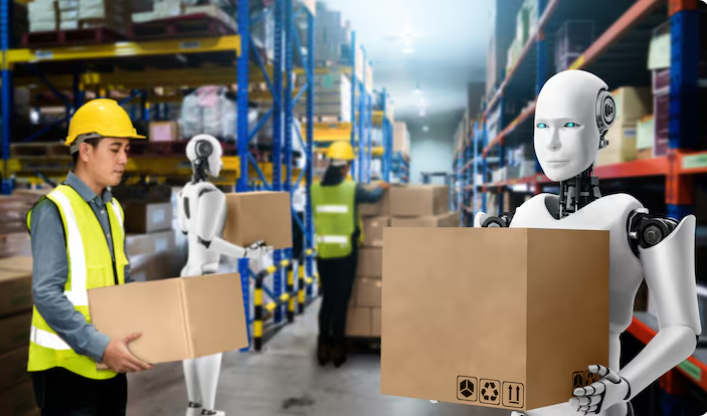

Before the employees even clock in, the shift has already begun inside a sizable fulfillment center on the outskirts of a mid-sized American city. This type of building, a low grey rectangle the length of several city blocks surrounded by loading docks and parking lots for thousands of vehicles, announces its size before you can read any signage.
An AI system somewhere in the facility’s server infrastructure is determining the distribution of tasks for the day, establishing individual pace expectations based on the throughput of the previous shift, and creating the performance benchmarks that will monitor each scan, step, and minute of departure from the anticipated workflow. Technically, the human shift supervisor is present. However, the majority of what was formerly their responsibility was already completed by the system before they even entered.
| Category | Details |
|---|---|
| Topic | Algorithmic Management in U.S. Warehouses |
| Key Company | Amazon (primary adopter) |
| Technology Type | AI task assignment, performance tracking, real-time quotas |
| Worker Acceptance Rate | 15% comfortable with AI boss (Quinnipiac poll, 2026) |
| Warehouse AI Adoption | 90%+ of warehouses using some form of AI/automation (late 2025) |
| Key Concern | Lack of human context — fatigue, injury, unexpected events |
| Surveillance Issue | Monitoring worker activity; potential unionization prediction/deterrence |
| “Great Flattening” | Reduction of human middle managers via AI coordination |
| Labor Impact | Workers treated as interchangeable units; high turnover |
| Reference Website |
The term “algorithmic management,” which labor researchers and workplace scholars have applied to what Amazon and an increasing number of logistics companies are implementing in their warehouse operations, refers to the use of AI systems to perform tasks that middle managers once performed, such as assigning tasks, setting quotas, monitoring performance, flagging deviations, and producing the reports that determine who gets the best shifts and who receives disciplinary attention.
On its own terms, the efficiency argument is simple and correct. No human supervisor working a twelve-hour shift could match the accuracy with which an algorithm overseeing ten thousand workers at once can optimize pick-and-pack routes, modify quotas in real time when demand spikes, and measure productivity metrics. Flattening the management structure results in significant labor cost savings.
The efficiency argument tends to underestimate what happens when the system encounters something that algorithms struggle with: a worker who is slowing down due to a developing injury, a section of the warehouse where equipment has been malfunctioning and causing delays, or a new employee whose pace metrics are suppressed by the job’s learning curve rather than by insufficient effort. A human manager who has collaborated with these individuals is able to distinguish between a poor employee and a lousy afternoon.
The metric target and whether it was met are known to the algorithm. The disparity between those two methods of assessing an individual’s work has resulted in the working conditions that Amazon and similar establishments have come under fire for: the constant pressure, the disputes surrounding the timing of bathroom breaks, the documented injury rates that surpass industry averages, and the high turnover that the system views as a reasonable expense while the employees it cycles through perceive it as something far more disruptive.
Only 15% of Americans would be at ease with an AI boss, according to a 2026 Quinnipiac poll. This figure illustrates the gap between how quickly corporations are adopting these systems and how employees truly feel about them. By late 2025, more than 90% of warehouses were utilizing advanced automation or artificial intelligence.
Companies running these facilities have mostly opted to address this gap as a communication or culture issue rather than a structural design issue due to the rapid institutional adoption and low worker approval rate. Labor relations experts in logistics are keeping a close eye on whether workers eventually adjust to algorithmic control or whether the opposition develops into something more structured.
Particular regulatory attention has been focused on the surveillance aspect. Artificial intelligence (AI) systems that track worker activities, such as location, pace, and time spent off-task, produce data that can be utilized for purposes other than productivity management. According to reports from labor researchers, certain systems have been set up to recognize behavioral patterns linked to union organizing activity, alerting employees for human review based on their interactions with coworkers and departures from personal work habits.
Because it uses workplace surveillance for both efficiency and the suppression of collective action, which American labor law is supposed to safeguard, this kind of algorithmic management raises the most serious concerns. Courts and Congress are debating these applications’ legal status without coming to a firm conclusion.
Walking through the economics of the “great flattening”—the corporate euphemism for replacing human middle management layers with generative AI coordination tools—gives the impression that while the savings are genuine, the costs are being dispersed unfairly. The businesses save money on overhead related to human resources and supervision pay. The loss of middle managers’ human judgment is absorbed by the employees, frequently without a commensurate raise in pay.
Gains in productivity are distributed to shareholders. The floor is under more pressure. The question of whether the trajectory of AI warehouse management ultimately results in the “human-centric” outcome that its proponents describe or something more akin to a system optimized for throughput at the expense of the people inside it is one that the technology is answering more quickly than the regulatory frameworks intended to govern it can keep up with.
