
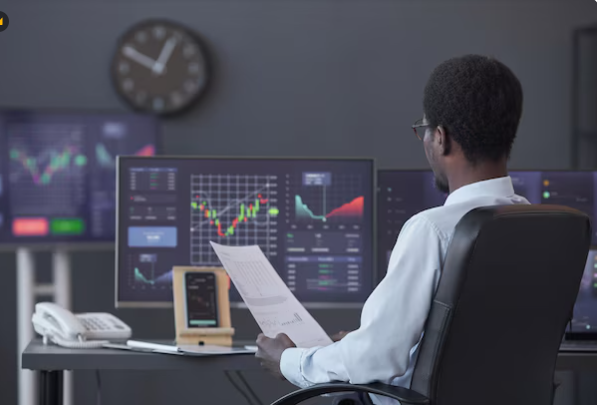

Even when no one is talking, a large hedge fund’s trading floor is noisy. The screens are on all the time. The order flows are always changing. There is information—a signal hidden in what appears to most spectators to be chaos—somewhere in the cacophony of bid-ask spreads updating in milliseconds, of limit orders being put, canceled, and placed again in patterns that no human eye can follow at full resolution. The whole competitive objective of quantitative trading is to extract that signal consistently and more quickly than everybody else trying the same thing.
The majority of the significant advancements in that project over the last ten years have come from machines discovering patterns from data at a scale that human cognition cannot match, rather than from astute human analysts creating novel theories about how markets function. The results of a new study by a group of researchers at the University of Oxford are at the pointy end of that trend, and trading desks pay close heed to the performance figures that go along with it.
Key Reference & Research Information
| Category | Details |
|---|---|
| Topic | Oxford-Developed AI Model for Hedge Fund Trading |
| Developing Institution | University of Oxford — Oxford-Man Institute of Quantitative Finance |
| Industry Partner | Man Group (Man AHL) — backing Oxford-Man Institute |
| AI Methodology | Machine learning + natural-language processing techniques applied to order book data |
| Data Source Used | Limit order book data — liquidity and sequential market movement |
| Prediction Accuracy | ~80% success rate in short-term trading trials |
| Prediction Horizon | 30 seconds to 2 minutes |
| Hardware Used | Graphcore Intelligence Processing Unit (IPU) — Bristol, UK |
| IPU vs GPU Performance | ~10x faster than traditional GPUs in testing |
| Primary Use Case | Optimizing execution of large stock orders for quant/algorithmic trading |
| Academic Program | Oxford Algorithmic Trading Programme — Saïd Business School / GetSmarter |
| Commercial Entity | Oxford Algorithms — proprietary ML software for investment strategies |
| Broader Trend | Shift toward AI-driven, market-neutral quantitative fund strategies |
| Reference Website | Oxford-Man Institute — oxford-man.ox.ac.uk |
The model, which was created in partnership with the Oxford-Man Institute of Quantitative Finance, a research facility supported by Man Group, one of the biggest quantitative hedge fund managers globally, uses machine learning techniques from natural language processing to solve the short-term price prediction problem.
The system analyzes limit order book data, which is the running record of buy and sell orders queued at different price levels, and finds patterns that consistently precede price changes in the thirty-second to two-minute window by framing market movement as a sequential learning task, much like language models learn to predict the next word in a sentence based on what came before. The system was about 80% accurate at predicting the direction of price movements in testing circumstances. If that figure remains consistent outside of controlled testing settings, it is hardly a slight improvement over current techniques. It’s a big advantage.
The research’s hardware component provides an intriguing dimension that can be overlooked in coverage that concentrates on the accuracy number. The Oxford team employed a Graphcore Intelligence Processing Unit, a chip created and produced in Bristol by a business that has been marketing itself as a substitute for Nvidia’s GPU architecture for particular AI tasks.
For the essential tasks, the IPU performed the trading model around 10 times faster in testing than conventional GPUs. In high-frequency trading, speed counts in ways that compound rapidly: a model operating ten times faster not only generates findings sooner but also permits more iterations, more data points, and the ability to act on forecasts before the conditions of the market have changed. The hardware selection was not accidental; rather, it is a conscious attempt to create a fast model that is tuned to the millisecond-sensitive environment in which the model is intended to function.
The research has a clear path for practical implementation thanks to Man Group’s institutional commitment through the Oxford-Man Institute. A model that can optimize large order execution at the time horizons the Oxford research addresses would be ideal for Man AHL, the quantitative trading division of Man Group, which operates out of London with strategies spanning international markets. Placing the entire position at once is not enough to execute a large institutional buy or sell order; doing so pushes the market against you.
The Oxford model is specifically made to anticipate short-term price direction, which is necessary for splitting and timing the order to minimize market impact. In this way, the application and the research are already in the same space.
It is important to take note of the larger academic community that surrounds this work. In collaboration with GetSmarter, the Saïd Business School at Oxford now provides an Algorithmic Trading Program that teaches financial professionals how to use AI-driven trading methods in real-world situations. This academic community gave rise to Oxford Algorithms, a private company that has been developing proprietary machine learning software for investment managers.
Through a variety of pathways, the university’s research is making its way into organizations and businesses that oversee substantial sums of money. One of the characteristics that sets the Oxford-Man project apart from pure academic research is its commercialization trajectory: the goal was always to generate something useful, not merely publishable.
Since real markets are messier than the historical data used for validation and the edge that 80% accuracy represents tends to compress as more participants adopt similar approaches and the signal becomes crowded, it is still unclear how the model performs outside of the carefully controlled conditions of research testing.
In quantitative finance, this is a well-known dynamic: a true discovery is successful until sufficient capital is following it, at which time the pattern it discovered is arbitraged away. There’s a sense that the window of maximal advantage is likely shorter than the headline accuracy figure indicates as the Oxford team’s work moves closer to deployment, but shorter doesn’t equal negligible for the funds that arrive first.
