

The Nordkettenbahnen cable car climbs 2,256 metres in thirty minutes. Step off in Innsbruck’s city centre at 9am, and by half past you’re standing at the Hafelekar mountain station, staring across the Karwendel range.
That proximity—between cobbled medieval streets and serious alpine terrain—sits at the heart of Innsbruck’s pitch to weekend travellers. The Tyrolean capital spans more than 40 surrounding locations across six distinct regions, each accessible via public transport included free with accommodation stays of two nights or longer.
It’s an ambitious claim in an increasingly crowded market. Salzburg offers imperial grandeur. Geneva provides alpine access with international flair. Innsbruck’s gamble rests on compression: fitting mountain trails, Baroque palaces, and Michelin-starred dining into a single three-day itinerary without the usual compromises.
The timing matters. Post-pandemic travel patterns show surging demand for short, rail-accessible breaks over long-haul flights. Innsbruck arrives by direct train from Munich, Vienna, and Zurich, plus air links from multiple UK airports. Once there, the Welcome Card—issued free by partner accommodation providers—covers buses and trains across the region.
No hire car required.
The practicalities shape the experience. On day one, that thirty-minute ascent to Hafelekar opens access to the Goetheweg trail, a high-altitude route named for the poet who walked these ridges. The geology-themed Geotrail offers an alternative for those more interested in rock formations than romantic literature. By early afternoon, visitors can descend back to the city centre for the Walks to Explore routes—themed itineraries threading through medieval alleyways past the Golden Roof and Habsburg residences.
It sounds breathless on paper. Whether it works in practice depends on pacing and priorities.
Day two shifts to cultural immersion. The Hofkirche Court Church, located at the edge of the old town, houses the elaborate tomb of Emperor Maximilian I—empty, despite the grandeur, as the emperor was buried elsewhere. The Schwarzen Mander bronze figures stand guard, larger than life and imposing in their detail.
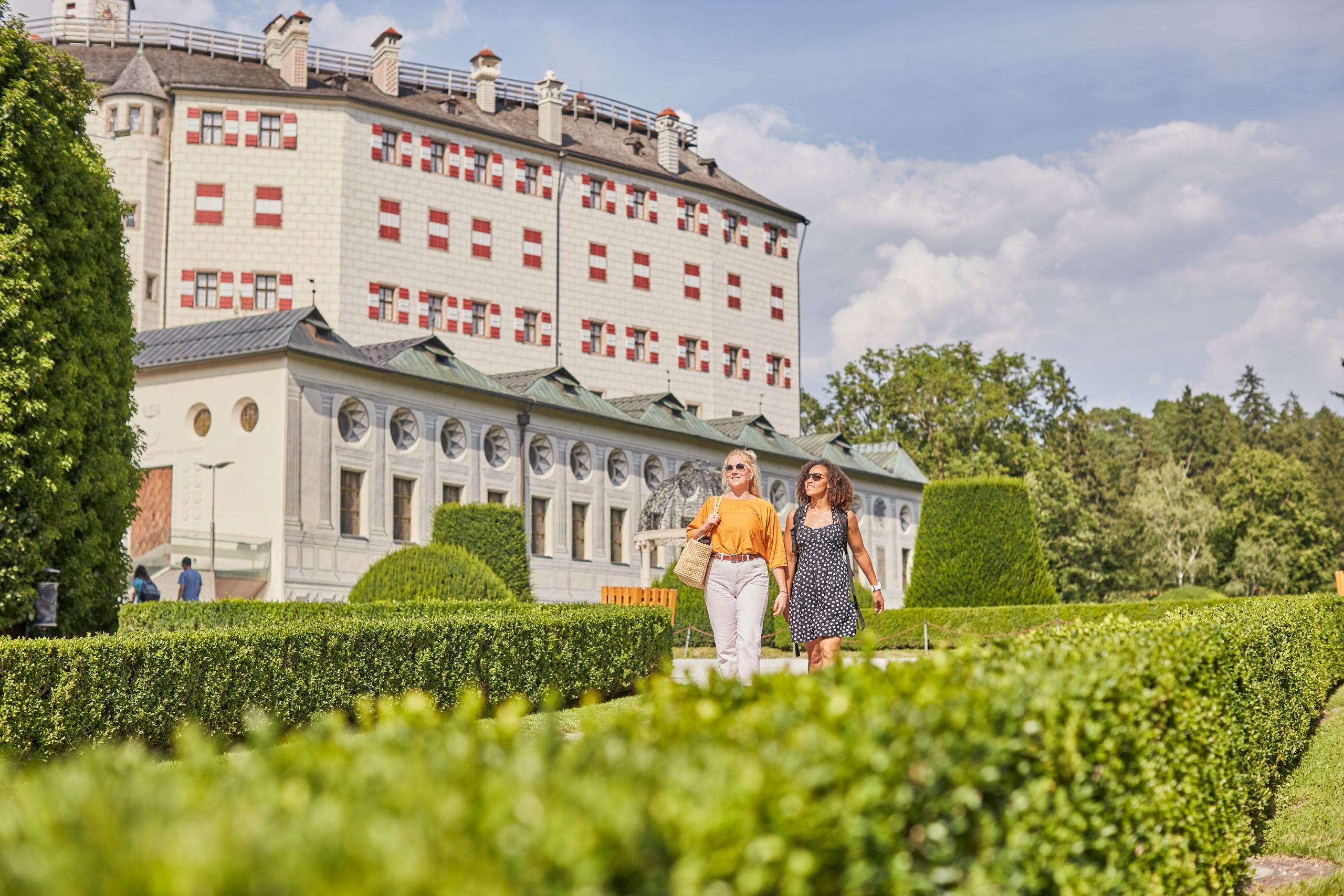
Next door, the Hofburg Imperial Palace showcases Baroque opulence. The Giant’s Hall dominates, its scale and decoration reflecting the ambitions of 18th-century royalty. Further out, Ambras Castle offers Renaissance collections of art, armour, and portraits set within parklands that invite slower exploration.
By afternoon, the itinerary suggests a short journey to Wattens, where Swarovski Crystal Worlds delivers something entirely different: contemporary installations and glittering exhibitions that feel worlds away from imperial history. The contrast is deliberate—urban heritage in the morning, modern spectacle by evening.
Day three focuses on movement and gastronomy. Trail runners will find routes across all abilities throughout the region, combining elevation gain with mountain views. But the more unusual offering is the Genuss-Radweg, a bike trail winding past 24 farm shops and producers selling dairy products, honey, and baked goods direct to visitors.
It’s food tourism on two wheels, and it positions Innsbruck beyond the typical alpine narrative of summits and skiing.
The finale—for those with budget and inclination—takes place on the sun-drenched Mieming Plateau. The 27-hole golf course provides one option. Restaurant 141 by Joachim Jaud at Alpenresort Schwarz provides another: two Michelin stars and four Gault&Millau toques in a mountain setting.
That combination—serious haute cuisine in alpine terrain—remains relatively rare in European tourism. Most Michelin dining clusters in major cities or coastal destinations. Innsbruck’s ability to deliver it within a three-day weekend break represents genuine differentiation.
The Innsbruck Card supports this compressed itinerary. Available for 24, 48, or 72 hours, it includes one return trip on the Nordkettenbahnen and Patscherkofelbahn cable cars, plus attraction access and local transport. The Welcome Card, issued free to guests staying at partner properties for at least two nights, extends regional travel and discounted entry across the six tourist regions: Innsbruck itself, Inntal-Telfs, Kühtai-Sellraintal, Mieminger Plateau, Patscherkofel Region, and Western Plateau.
Both products push visitors toward public transport over hire cars, supporting sustainability claims while simplifying logistics.
Innsbruck Tourismus, the destination management organisation behind this positioning, employs around 100 staff across eleven tourist information offices. The infrastructure exists to support the promise—though whether three days genuinely suffices to experience six regions, multiple mountain ascents, palace tours, and two-star dining remains an open question.
What’s clear is the strategy: compress alpine experiences and urban culture into a tight, rail-accessible package aimed squarely at time-poor travellers seeking alternatives to beach resorts or city-only breaks.
For operators building touring itineraries or active travel programmes, the six-region spread offers flexibility. Trail runners, cultural tourists, and food-focused travellers can all find anchors within the destination. The Hauptbahnhof station provides the hub, with routes radiating outward to alpine villages and mountain access points.
The model isn’t unique—Swiss and Austrian destinations have long promoted integrated transport and accommodation packages. But Innsbruck’s specific combination—capital-city sophistication, immediate mountain proximity, Michelin dining, and free regional transport—creates a distinct offer in the competitive alpine market.
Whether weekend visitors genuinely engage with all six regions or stick to the city and Nordkette remains to be seen. The infrastructure supports ambition. The Welcome Card removes financial barriers to exploration. The question becomes whether three days encourages depth or breeds superficiality.
For now, that cable car keeps climbing. Thirty minutes from cobblestones to 2,256 metres, with Baroque palaces and farm-shop bike trails somewhere in between.
