
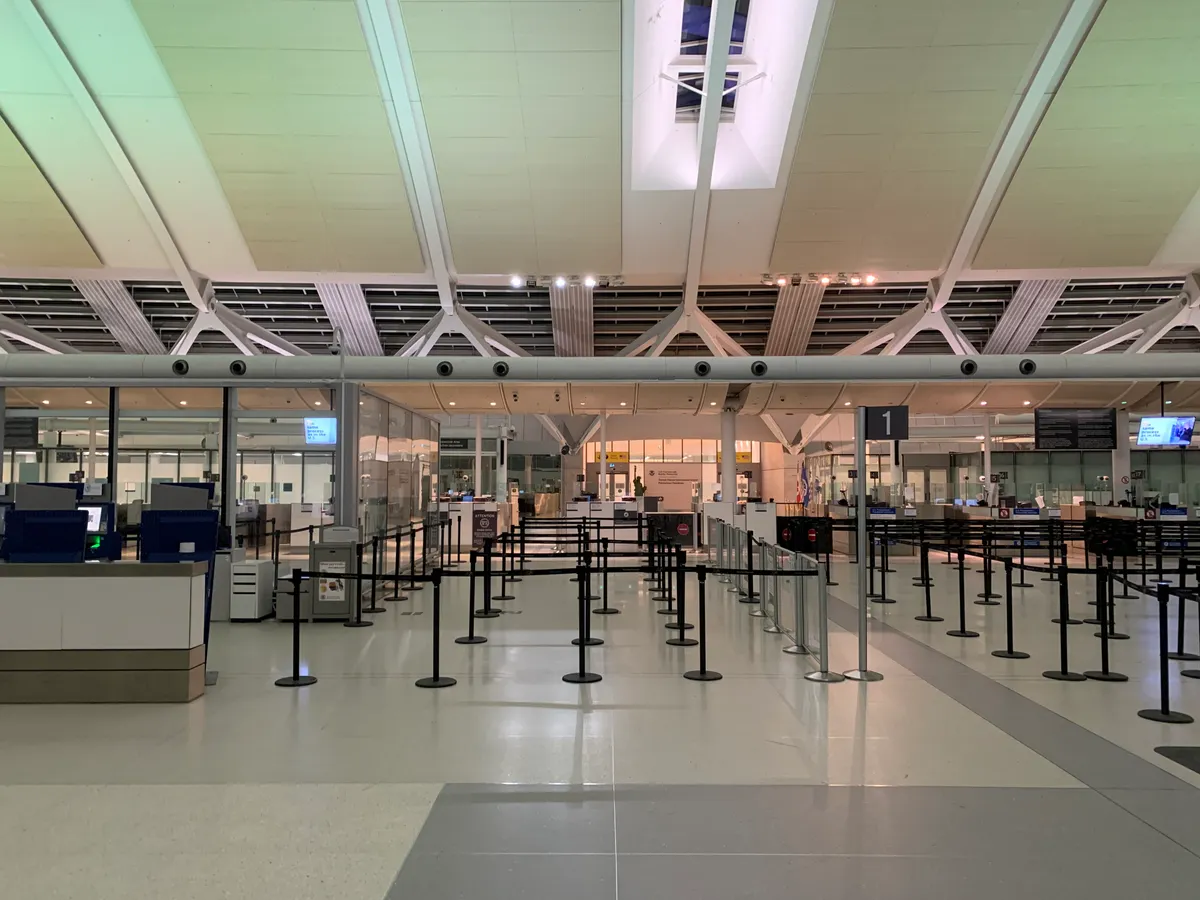

The Transportation Security Administration has confirmed that improper carriage of firearms remains the leading cause of TSA PreCheck firearm ban enforcement, with passengers facing a minimum five-year revocation of PreCheck privileges and fines of up to $14,950 for violations of weapon-declaration procedures.
The consequences extend beyond financial penalties. Once PreCheck status is revoked, affected passengers face additional security checks on every subsequent airport visit, adding time and friction to each journey. In the most serious cases, arrest remains a possibility.
TSA PreCheck Firearm Ban Enforcement: The Scale of the Problem
The volume of weapons intercepted at security checkpoints underlines why the TSA treats the issue as a priority enforcement area. Nationwide, 6,678 firearms were intercepted in 2024, according to official TSA data. The airports recording the highest detection numbers included Hartsfield-Jackson Atlanta International, Austin-Bergstrom International, Dallas/Fort Worth International, Dallas Love Field, Denver International, George Bush Intercontinental, Nashville International, Orlando International, Phoenix Sky Harbor International, and Tampa International.
The pattern has continued into 2025. According to a TSA press release, officers at San Antonio International Airport detected 49 firearms at the security checkpoint during routine X-ray screening of carry-on property since 1 January 2025. Of those 49 firearms, 43 were loaded, a figure that illustrates both the frequency of violations and the potential risk to other passengers. Some TSA reporting indicates that close to 20 weapons are confiscated daily across the network.
The problem is not confined to conventional firearms. In June 2025, TSA agents in Detroit discovered a hand grenade in a traveller’s luggage, according to a TSA press release. Replica weapons are also prohibited, as they can generate disruption at checkpoints in the same way as genuine items.
What the Rules Actually Require, and Why So Many Passengers Get Them Wrong
Flying with a legally owned firearm is permitted under TSA rules, provided the passenger follows a specific set of procedures. The weapon must travel in checked baggage only, never in a carry-on bag. It must be unloaded and stored in a locked, hard-sided container that completely secures the firearm from access, a requirement that excludes cases that can be forced open easily, and does not automatically include the original manufacturer’s packaging.
Ammunition is likewise prohibited from carry-on bags. At check-in, passengers are required to declare each firearm to the airline; failure to do so can itself trigger penalties. Airlines may also impose their own additional limitations or fees, so checking with the carrier ahead of travel is a necessary step.
The TSA PreCheck programme, which operates across approximately 200 airports and covers more than 100 airlines, is structured as a risk-based screening benefit, not an entitlement. The TSA describes it as a programme that ‘makes risk assessments about passengers prior to their arrival at an airport checkpoint’ and ‘enhances aviation security.’ Enrolment costs $85 for a five-year term, and members are spared the standard requirements to remove belts, light jackets, laptops and liquids at the checkpoint.
Eligibility extends to US citizens, lawful permanent residents, members of Global Entry, SENTRI, NEXUS, and the US Armed Forces. Losing that status, through a firearm violation or other breaches such as packing prohibited items or providing false information during identity verification, means reverting to standard screening queues for a minimum of five years, and potentially permanently.
Improperly travelling with a weapon is the most common single trigger for revocation, according to the TSA. The San Antonio data, showing 43 loaded firearms found in carry-on bags in the first part of 2025 alone, suggests that awareness of the rules remains low among a portion of the travelling public, with consequences that are anything but minor for those caught.
