
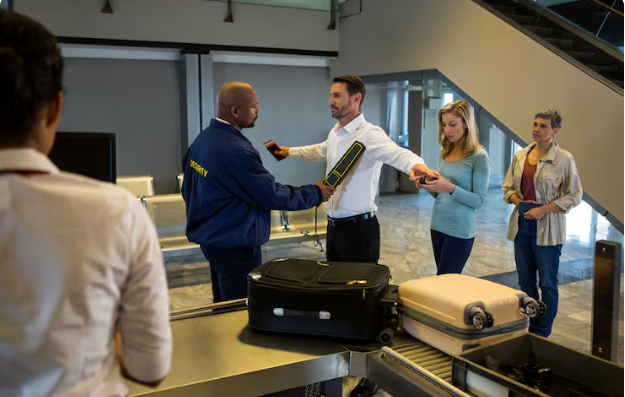

On a recent gloomy morning at Southampton Airport, travelers with plastic bags stuffed with tiny toiletries approached security with the customary silent fear. However, an odd thing occurred. A number of people passed through without taking out their laptops or unpacking their liquids, and they gave a quick glance back as though they were waiting for a call. Nobody did. There was a moment of bewilderment, almost disbelief, as the line moved more quickly than anticipated.
In an effort to address one of the most enduring annoyances of contemporary travel, UK airports have started testing what they refer to as dynamic security lanes, which are driven by artificial intelligence and sophisticated CT scanners. Security personnel can view items in layers rather than shadows thanks to the machines’ detailed three-dimensional images of bags that are silently humming behind glass panels. This could make all the difference. Or it makes an effort.
| Airport Group | AGS Airports Ltd (Aberdeen, Glasgow, Southampton) |
|---|---|
| Country | United Kingdom |
| New Technology | AI-powered threat detection and CT security scanners |
| Key Feature | Liquids up to 2 liters allowed in bags (with CT scanners) |
| Major Airports Involved | Heathrow, Gatwick, Manchester, London City |
| Government Deadline | Full rollout expected by 2025 |
| Goal | Reduce wait times and improve passenger experience |
| Reference |
The technology is being tested at AGS Airports Ltd.’s Aberdeen and Glasgow airports as part of a project called Project DARTMOUTH. As bags go through scanners, cameras and AI software watch them and automatically flag any possible threats. Observing the system in operation reveals an oddly serene quality. There are fewer alarms. Reduce the amount of shouting. Less hasty repackaging of possessions.
The routine for airport security has been the same for decades. Take off your shoes. Out with the laptop. The liquids separated. Passengers hardly ever questioned the ritual anymore because it had become so commonplace. However, there is a feeling that the previous system may have been more brittle than anyone acknowledged when one is standing in these more modern lanes, where people merely set their bags down and move on.
The CT scanners themselves have a somewhat medical feel to them, more like hospital equipment than airport equipment. The regulations that have governed air travel since the early 2000s are put to the test by their capacity to scan liquids up to two liters without the need for removal. Following terrorist threats involving liquid explosives, those restrictions changed the way people packed their bags. Even though many travelers are still wary, it feels important to see those regulations subtly relaxed.
Not all airports have completely embraced the technology. In order to make room for the larger scanners, Heathrow and Manchester are spending millions rebuilding entire checkpoints. However, the UK government was forced to extend its deadline to 2025 due to the complexity of installation. Terminals now have clumsy temporary security layouts and construction barriers that suggest a system that is still evolving.
Another experiment is taking place at Gatwick. In order to cut down on wait times, the airport implemented what it refers to as a “Call Forward” system, which dynamically modifies passenger flow. Screens smooth out unexpected spikes by indicating when passengers should approach. Ninety-five percent of passengers should be processed in five minutes, according to airport officials. It sounds like a big goal. It may even be possible, observing the steady flow of travelers.
The way passengers respond varies. Some people welcome the change and move through security with assurance and without hesitation. Others proceed cautiously, taking their laptops away anyhow, as though instruction is superseded by muscle memory. The hesitation, which is the result of years of habit and fear of making a mistake, is difficult to ignore.
Airport managers and airlines appear excited about the change. Smoother operations, fewer delays, and less terminal crowding are all results of faster security. Efficiency improvements are probably going to translate into happier passengers and ultimately better financial results for investors. However, it’s still unclear if bottlenecks can be completely removed by technology alone.
The silent issue of trust is another. Previously relying solely on human judgment, AI systems now help identify threats and make decisions. There is a mixture of comfort and anxiety as bags pass through scanners with little assistance. Machines never grow weary. However, they also fail to provide an explanation.
The wider implications go beyond practicality. People’s perceptions of flying are influenced by security protocols. Tension is created by long lines. Calm is produced by efficient lanes. Recently, passing through a checkpoint that was almost deserted, there was a fleeting, strange sensation—something near ease.
The rollout is still uneven, though. Travelers who switch between terminals are confused by the fact that many UK airports still adhere to the outdated 100ml liquid rule. Indications point to limitations that technology has already started to surpass. As a result, there is an odd overlap between the past and the future.
As this is happening, it seems like airports are subtly renegotiating their relationship with travelers. Safety is no longer the main objective. It’s velocity. Flow. Comfort. Security isn’t going away. However, it is evolving, becoming less noticeable and obtrusive.
Additionally, in some parts of Britain, passing through airport security feels more like a doorway than a barrier for the first time in years.
