
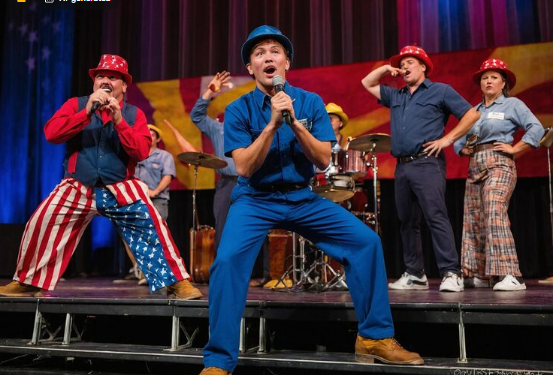

Every year, something completely warmer replaces the summer light as it starts to fade a bit across Melbourne’s skyline. Laughter. The streets are alive with foot traffic and jokes for three and a half weeks. The air is filled with the distinctively buoyant expectation of good humor, rather than tension, as posters are displayed in coffee shop windows. It’s almost musical—the city’s rhythm changes, like a radio tuning into a frequency that comedy alone can supply.
The festival, which is anchored by the imposing Melbourne Town Hall, turns both public and private spaces into transient theaters of laughter. Deadpan comedians, lyrical storytellers, satirical giants, and absurdist fringe acts all coexist without hierarchy, which is what makes it so beautiful. You could go from a pub basement with an up-and-coming Irish artist one evening to a national headliners’ sold-out gala the next.
Melbourne International Comedy Festival: Feature Overview
| Detail | Description |
|---|---|
| Location | Melbourne, Victoria, Australia |
| First Year Held | 1987 |
| Duration | 3.5 weeks annually in Autumn |
| Notable Venues | Melbourne Town Hall, Trades Hall, Arts Centre Melbourne |
| International Recognition | Among top 3 global comedy festivals (alongside Edinburgh Fringe, Just for Laughs) |
| Typical Features | Stand-up, cabaret, theatre, improv, street performances |
| Festival Artwork (1988–2018) | Illustrated by Michael Leunig |
| Festival Artwork (2019–2020) | Illustrated by Judy Horacek |
| Credible Reference | https://www.comedyfestival.com.au/ |
Part of what makes Melbourne’s strategy so novel is its adaptability. Melbourne supports its performers, in contrast to Edinburgh’s fiercely competitive scene, where artists occasionally talk about “survival” rather than celebration. Of course, ambition still exists, but it is tempered with a healthy dose of camaraderie.
Melbourne was just more fun, Peter Helliar once joked. And you believe a performer when you see him riff loosely with the audience, test unfinished material, or share vulnerable anecdotes. Although the players are kindly not, the festival fosters an environment where the stakes are high.
One year, while I was standing at the back of a Trades Hall performance, I noticed that the tech operator was laughing just as loudly as the front row. This told me something about the atmosphere backstage.
Melbourne incorporates foreign performers into the storyline rather than merely welcoming them. You might witness a Sri Lankan-Australian comedian analyzing diaspora identity, a Canadian improv duo, and a South African puppet show (yes, really) to end the evening. It seems less like programming and more like a continuous discussion about what comedy can be and for whom.
However, criticism of the festival has not gone unnoticed. Concerns regarding the festival’s structural dynamics, specifically how official programming might disadvantage independently funded Australian performers, have been voiced by local producers such as Lorin Clarke. Although the conflict between institutional support and grassroots energy is not new, it has become more apparent in recent years. Festivals around the world struggle to strike a balance between artistic risk and commercial viability. To its credit, Melbourne has demonstrated an openness to hearing.
That’s not to say there aren’t any mistakes. It was subtly symbolic that Judy Horacek replaced Michael Leunig as the official artist. Once adored for his fanciful illustrations, Leunig had grown more divisive; his later views on marriage equality and vaccines conflicted with the festival’s progressive spirit. Horacek’s tenure echoed the festival’s growing embrace of comedy by bringing an atmosphere of inclusivity and gentle provocation.
All of this is influenced by the city itself. Like any committee, the festival’s identity has been shaped by its alleyways, its erratic skies, and its audiences—intelligent, inquisitive, and frequently compassionate. Melbourne not only organizes the event but also takes part in it, attracting performers in novel ways. Even passing a chalkboard sign announcing an open-mic time at 10:45 PM causes you to notice that slight change in tempo.
The festival’s integration into the cultural norm is one of the things that sets it apart. It’s a regular social calendar event rather than just a seasonal attraction. In addition to purchasing tickets, people organize evenings around it, invite friends from out of state, and reserve nearby dining establishments. The humor serves as a background for other pleasures.
It serves as a springboard for up-and-coming comics, a workshop for seasoned comics before more extensive tours, and—perhaps most importantly—a reminder to audiences that humor isn’t just about the punchline. It’s about recognition sometimes. That tiny flicker of recognition in someone else’s voice. That shared chuckle during an otherwise challenging year.
The way laughter reverberates through crowded tram stops and historic buildings has a deeply democratic quality that serves as a reminder that comedy is a shared need rather than a luxury. And that’s how Melbourne, more than any other city, handles it.
With programming hinting at a rise in experimental formats and hybrid performances, the 2026 edition is expected to be especially ambitious. There are upcoming shows that combine comedy with animation, music, and even scripts created by artificial intelligence. Although it may sound new, it seems like a logical next step in a city that values both tradition and bold innovation.
If festivals serve as a window into their host cities, Melbourne’s reflects a culture that values conversation, rejects simple categorization, and finds joy in little, surprising turns. Like comedy itself.
