
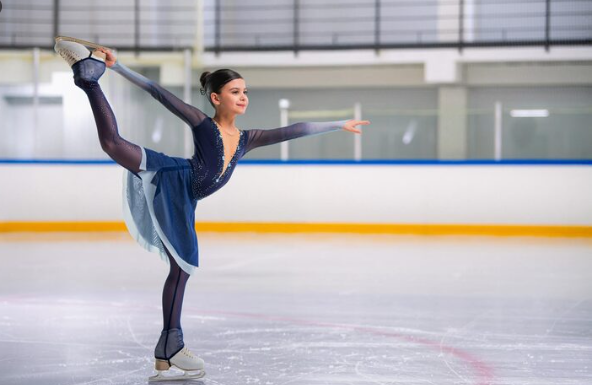

When you take into account the scope of Alysa Liu’s accomplishments, her projected net worth of $500,000 feels fairly low. gold medalist at the Olympics. champion of the world. A national talent. However, the spectacle is rarely matched by the finances of figure skating.
You had to go back to a little rink in California, where a child who was barely tall enough to reach the boards was already trying quadruple jumps, in order to comprehend her financial narrative. At the age of 13, Liu broke Tara Lipinski’s long-standing record as the youngest skater to ever win the U.S. Figure Skating Championships in 2019. When she landed triple Axels with unnerving ease, the arena was electrified and the audience buzzed in disbelief. She was obviously unique.
| Category | Details |
|---|---|
| Full Name | Alysa Liu |
| Profession | Figure Skater (Retired & Returned) |
| Estimated Net Worth | $500,000 |
| Born | August 8, 2005 |
| Major Achievement | Youngest U.S. National Champion (2019) |
| Olympic Success | 2026 Winter Olympics Gold Medalist |
| World Titles | World Champion (Post-Return) |
| Operation Gold Award | $37,500 per Gold Medal |
| Reference | https://www.usfigureskating.org |
She advanced quickly and unrelentingly through the American system. She dominated Challenger Series competitions, defended her national championship in 2020, and placed eighth for the United States at the 2022 Winter Olympics. Only the second American woman to medal at the World Championships since 2006, she went on to win a bronze medal there. Then, without warning, she stopped.
Liu gave up competitive skating at the age of 16 due to exhaustion. At that term, it’s difficult not to halt. Burnout at age sixteen. Her demeanor when watching interviews from that time period shows a mixture of relief and exhaustion, as though leaving the ice was both essential and frightening.
Arthur Liu, her father, disclosed that he had contributed between $500,000 and $1 million to her career. Figure skating is a costly sport that is frequently privately funded. This includes coaching fees, choreography, costumes, travel, and ice time. In a televised interview, he declared, “I spared no money, no time.” That type of investment is risky for a lot of families. It might have felt like duty to Alysa.
She once acknowledged that it was essentially his business. That integrity endures. The distinction between pressure and passion can be muddled in elite sports. She retreated from control as well as from competition after retiring. The conditions had altered by the time she returned almost two years later.
She picked her own music now. She contributed to the choreography. She kept track of her training timetable. She said, half-jokingly but very seriously, “No one is going to starve me.” There is a discernible change when you watch her skate upon her comeback—less desperate haste, more purpose. It was not a symbolic return. It was in charge.
Liu became the first American woman to win Olympic gold in the women’s individual event in twenty-four years while dancing to Donna Summer’s “MacArthur Park.” The U.S. Olympic and Paralympic Committee may award her with $75,000 in Operation Gold Awards if she won gold in the team competition.
Although the prize money is significant, it is not very transformational. The main sources of revenue for elite figure skaters are show appearances, sponsorships, and endorsements. Her success at the Olympics might greatly increase such prospects. Redeemer arcs are a popular choice for brands. An athlete who leaves and comes back stronger has a certain allure.
Her career is still in its early stages, as evidenced by her projected net worth of $500,000. She’s young. Sponsorship agreements may expand. There may be endorsements and exhibition trips after. It appears that sponsors—or rather, investors—think her tale will endure.
However, fame in figure skating is frequently short-lived. Skating careers are based on momentum and medals, as opposed to international sports leagues that offer guaranteed contracts. The headlines change with one injury and one missed jump. However, Liu’s reimagining implies longevity.
When I watched her skate over Olympic ice in 2026, I noticed a poise that wasn’t there when she was 13. The technical difficulties and the jumps were intact, but control seemed to have taken the place of the sense of urgency. That control might turn out to be as profitable as it was competitive.
