
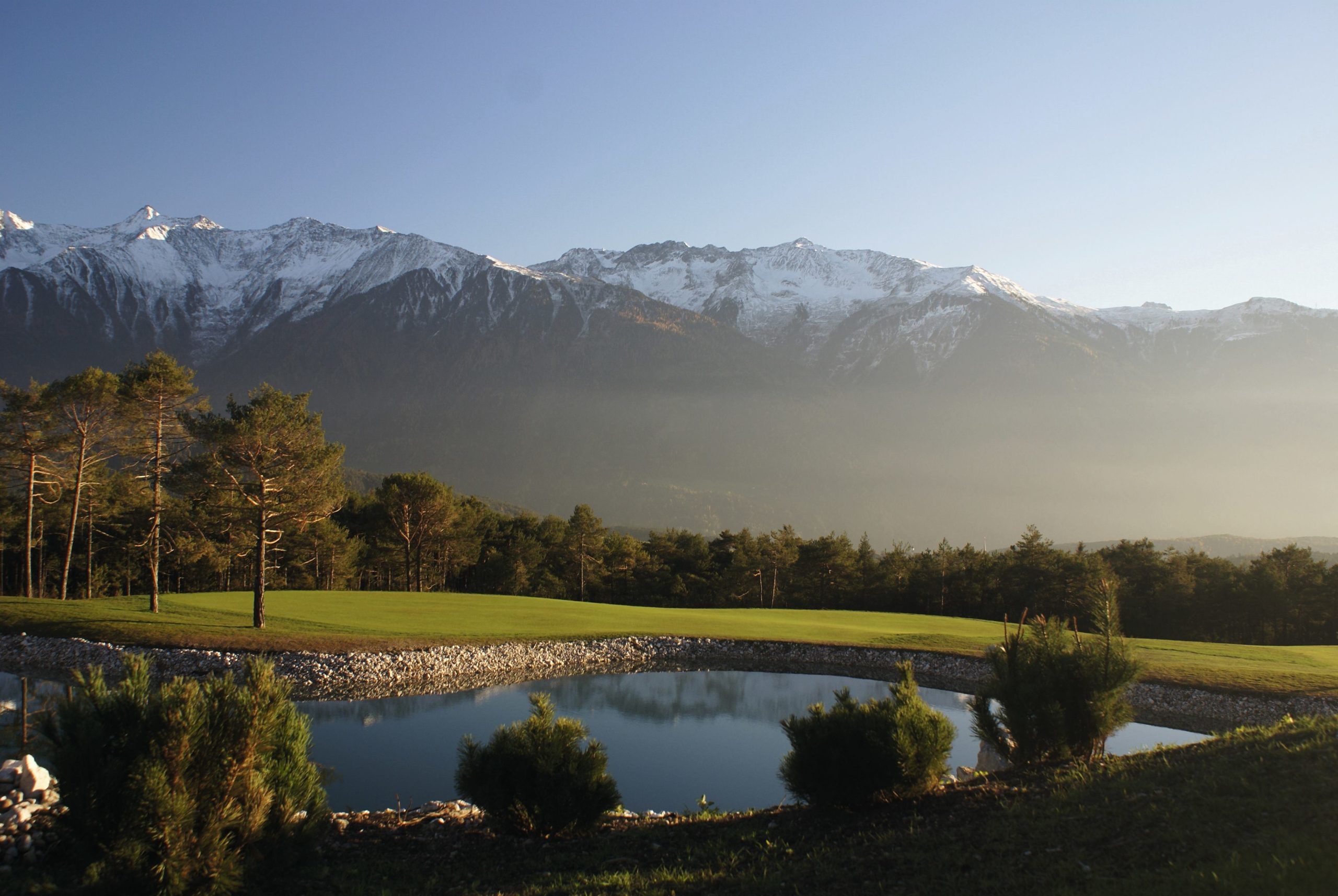

At 2,020 metres above Kühtai, ski lifts will spin through the end of April. Down in the valley, 90 minutes away by car, the Golfpark Mieminger Plateau opens its 27-hole course this week.
Welcome to spring in the Austrian Alps, where the season refuses to pick a side.
Innsbruck and the 40-plus villages surrounding Tyrol’s capital are leaning into the paradox. While competitors across the Alps wind down winter operations, the region is marketing what amounts to two simultaneous seasons—high-altitude skiing on three separate mountains whilst trail runners pound valley paths and cyclists trace the River Inn through Germany, Austria and Switzerland.
The strategy targets what tourism officials call “active travellers”—visitors who might ski the Stubai Glacier in the morning, 50 minutes from the city centre by public transport, then cycle through wildflower meadows by afternoon.
Whether enough tourists want that kind of split personality remains an open question.
The Axamer Lizum ski area plans to operate until mid-April, culminating in its annual Ugly Skiing Day—an event whose name suggests an industry comfortable acknowledging its own absurdity. By then, the lower trails along the Rivers Inn and Sill will have been ice-free for weeks, already filling with runners reintroducing themselves to the sport after winter.
The Höttinger-Höfe trail, once it sheds its snow, climbs through pine forest and past historic farms to 735 metres above sea level. It’s steep enough to challenge, gentle enough to survive. Exactly the sort of route that works when legs haven’t seen serious elevation since October.
Meanwhile, the Stubai Glacier—technically a separate operation but marketed as part of the Innsbruck experience—extends skiing into May. The glacier’s longevity matters less for its snow reliability than for what it signals: Innsbruck isn’t ready to surrender to spring.
Not yet.
Down in the city, the transition shows more clearly. Maria-Theresien-Strasse, Innsbruck’s elegant main boulevard, sprouts café terraces as temperatures climb. The market square, which offers postcard views of the Nordkette mountains and the colourful Mariahilf houses along the River Inn, will host the traditional Easter Market from 27 March to 6 April.
Local handicrafts, regional specialities, live music. The usual Easter fare, though the timing—straddling late March and early April—suggests organisers remain uncertain when spring actually arrives here.
To be fair, uncertainty defines the season. Weather shifts rapidly. A sunny morning can surrender to afternoon snow at higher elevations, even as valley floors bake under uninterrupted sun. Tourists planning active holidays need flexibility, or at least low expectations about itinerary precision.
The Golfpark Mieminger Plateau illustrates the gamble. The course, designated one of Austria’s official Leading Golf Courses since 2025, sits amid lush meadows with the snow-capped Mieming mountain range rising behind it. Often opening by mid-March, it depends entirely on valley temperatures cooperating.
When conditions align, few settings rival it. When they don’t, golfers find themselves staring at a closed course whilst skiers above enjoy perfect conditions.
Cycling faces fewer weather dependencies, which explains why Innsbruck Tourismus pushes it heavily during spring. The Inn Cycle Path, following the river as it meanders across three countries, offers gentle terrain suitable for families. The section west toward Silz passes 24 locations serving local honey, schnapps, sausages and home-made bread—a route designed as much for stopping as cycling.
The Rund um Natters circuit winds through forests and meadows before passing through the Tyrolean village of Natters itself. It’s precisely the sort of relaxed, family-friendly route that tourism boards love because it requires minimal fitness and generates maximum positive reviews.
Trail running, by contrast, attracts a narrower demographic but one with disposable income and a willingness to travel for terrain. Longer days and milder temperatures mark the season’s start, though “milder” remains relative at altitude. The Innsbruck region’s network of routes weaves through flowering meadows, forest paths and alongside rushing streams—assuming those streams aren’t still frozen.
What’s notable is the breadth of what’s being offered simultaneously. Innsbruck isn’t pivoting from winter to spring; it’s attempting both.
That approach distinguishes it from other Alpine destinations that make cleaner seasonal breaks. Whether it works depends on attracting visitors comfortable with contradiction—those willing to pack ski gear and cycling shoes in the same bag.
The region’s free Welcome Card, offering access to various attractions and local public transport, helps justify the logistical complexity. So does Innsbruck’s compact geography: the city sits close enough to multiple mountains that switching activities doesn’t require changing hotels.
Innsbruck Tourismus, the destination management organisation employing roughly 100 people across eleven tourist information offices, markets the diversity as strength rather than confusion. Their messaging emphasises “harmony with local communities and natural surroundings,” though what’s actually happening is an ambitious attempt to extract revenue from a transitional season most destinations treat as downtime.
By May, the decision resolves itself. The Stubai Glacier closes. Golf courses settle into reliable operation. Cyclists no longer worry about ice patches. Trail runners stop checking snow reports.
Until then, Innsbruck occupies a peculiar space—simultaneously winter and spring, mountain and valley, snow and blossom. Whether tourists find that appealing or exhausting will determine if other Alpine regions follow the strategy or stick with cleaner seasonal boundaries.
For now, the ski lifts keep spinning whilst the meadows turn green below. The Easter Market opens in three weeks. The Golfpark Mieminger Plateau awaits warmer weather. And somewhere above Kühtai, skiers are enjoying conditions that won’t last much longer.
Spring is coming, officials insist. But winter isn’t leaving quietly.
