
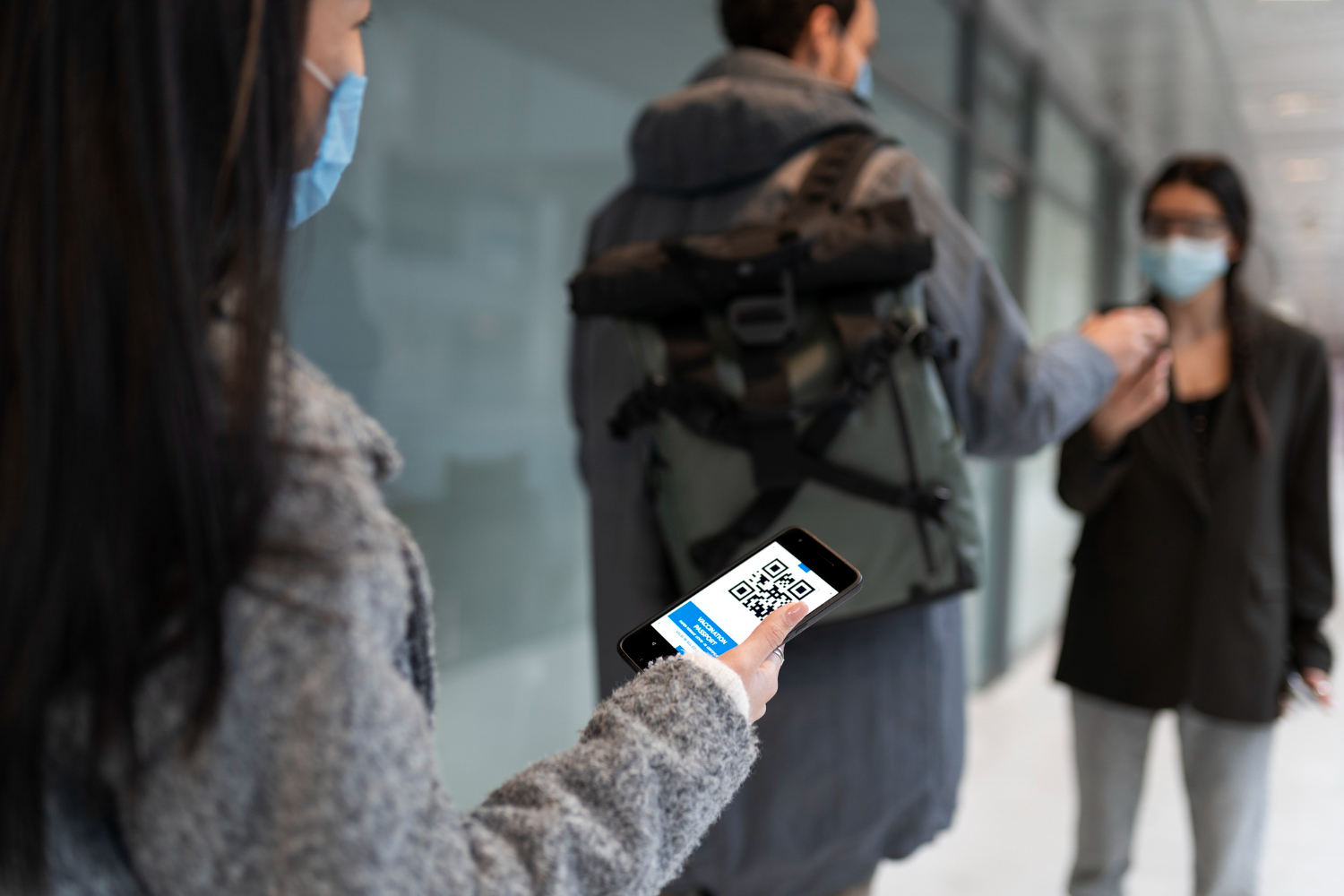

A woman in her seventies skipped the standard ID shuffle at the Phoenix airport. She breezed through TSA with a Face ID scan and two fast taps on her iPhone. A family stood behind her, clearly in awe. No searching, no paper trail—just a smooth advance.
Digital IDs are no longer just hypothetical. They’ve subtly moved from tech previews to functional reality, especially at airports and borders where identity checks have long caused delays. Identification is changing incredibly quickly these days, moving from your wallet to your smartphone and possibly even to cloud-based encrypted credentials.
| Feature | Description |
|---|---|
| Biometric Integration | Uses facial scans, fingerprints, and encrypted ID tokens at checkpoints |
| U.S. TSA Compatibility | Over 250 airports now verify digital IDs via Apple or Google Wallet |
| EU Entry/Exit System (EES) | Tracks biometric data, replacing physical passport stamping |
| International Role | Digital IDs support passports but cannot fully replace them (yet) |
| Key Risk Areas | Vulnerable to data breaches, outages, and misuse of personal biometrics |
| Regulatory Efforts | ICAO building global standards for secure digital travel credentials |
| Backup Necessity | Travelers must still carry a physical ID or passport as backup |
More than 250 airports in the United States currently accept digital ID verification through Google Wallet and Apple Wallet. In 2025, the TSA started to broaden this capability, enabling domestic travelers to use digital credentials to navigate security. Although the change is very practical, travel abroad is still less flexible. The official entry point is still traditional passports.
On the other side of the Atlantic, the European Union is implementing its Entry/Exit System (EES) gradually. This method uses biometric records—scanning travelers’ faces and fingerprints to track cross-border movement—instead of passport stamps. Faster throughput and shorter lines are promised by this remarkably efficient framework.
A new step will be added in 2026. Similar to the U.S. ESTA, the ETIAS screening system will require non-EU visitors to provide information in advance of their visit. These initiatives work together to create a remarkably sophisticated digital border infrastructure.
Both U.S. and EU systems seek to improve security and expedite processing by utilizing biometric authentication and encrypted identity tokens. Without needless manual checks, these techniques are incredibly successful at lowering the risk of forgeries and guaranteeing that documents match the traveler.
A global initiative to standardize digital travel credentials is being led by the International Civil Aviation Organization. If this were to happen, your passport would be able to live safely on your phone, updated automatically, and accepted around the world. Although the project is still in its early stages, it represents a particularly creative change in cross-border mobility.
Recently, as I was going over the technical drafts of ICAO, I found myself stopping. The direction was unmistakably clear despite the dense language: digital identities are being created to move freely, just like people. Nevertheless, we continue to print boarding passes and hold plastic cards.
Both pressure and promise accompany this change. Biometric information needs to be extremely rigorously protected. It is possible to reset a password that has been stolen. The consequences are far more dire if your facial scan is compromised. Because of this, technologies like multi-layer encryption and decentralized storage are necessary rather than optional.
Digital systems have already experienced outages during periods of high travel demand. In the last year, biometric failures at JFK and London Heathrow forced employees to switch back to manual verification. These incidents served as a potent reminder that robust, analog foundations are essential for any digital solution.
The question of consent is equally significant. It is common for travelers to click “accept” without actually reading what they are approving. It’s simple to overlook the small print in crowded lines and strange kiosks. In order to guarantee that travelers maintain ownership of their biometric data and are aware of the location and duration of its storage, privacy advocates have been especially outspoken.
In an effort to modernize public service access, the UK government of Prime Minister Keir Starmer has launched a digital ID program. However, the policy has generated discussion. Despite being marketed as a convenient tool, detractors caution that it might be used for immigration enforcement or surveillance purposes. Once static and analog, identity is now more dynamic and disputed.
In the meantime, Apple has unveiled a remarkably safe way for Americans to generate digital identification cards straight from their passports. It entails scanning the document, reading its chip, and taking a selfie that is validated by minute facial expressions. Only the user’s device stores that image, which serves as the ID’s biometric anchor.
This strategy is especially advantageous. Travelers now have more control over what information they disclose and when. Digital IDs enable selective disclosure, such as proving legal age without revealing extraneous information, as opposed to flashing a physical card that contains the full name, date of birth, and address.
However, not everyone is prepared for the change. Travelers who are concerned about their privacy, residents of areas without digital infrastructure, and seniors who are not familiar with smartphones may be hesitant. Systems run the risk of causing new divisions while attempting to bridge existing ones if inclusivity is not prioritized in their design.
As of right now, a physical backup is still necessary for all major digital ID programs. Travelers are advised to bring standard documents, such as a passport, driver’s license, or national ID. This redundancy is a useful precaution rather than a weakness.
Identity is very personal. It includes access, mobility, and trust. A passport is a symbol, not just a key. The advent of borders that read faces rather than pages ushers in a time when establishing one’s identity is both quicker and more difficult.
Governments are changing mobility by incorporating digital identity into travel practices. The question is now one of responsibility rather than possibility. The true test of success as the technology develops will be how carefully it incorporates everyone it comes into contact with.
