
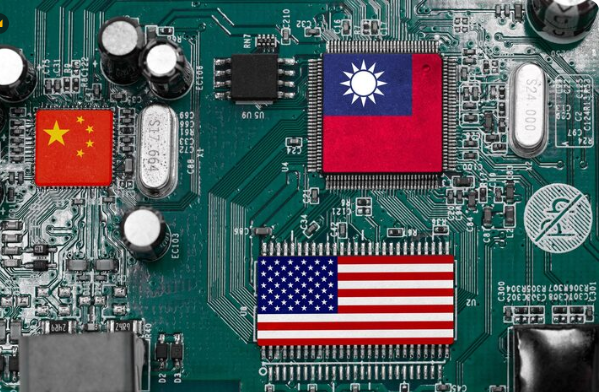

Taiwan’s renowned technology park is bustling day and night on the outskirts of Hsinchu. Before morning, delivery trucks arrive in silence. Inside the enormous fabrication facilities, robotic arms move over gleaming floors with silicon wafers that appear nearly delicate in fluorescent light. However, almost everything that modern life depends on is powered by those wafers, including fighter jets, smartphones, cloud servers, and increasingly artificial intelligence.
It is clear from standing outside one of these facilities why the semiconductor industry is currently the focus of unusually intense geopolitics. In the past, engineers and investors were the only people who talked about chips. These days, their strategic significance is more akin to that of oil.
Key Information About the Global Semiconductor Landscape
| Category | Information |
|---|---|
| Industry | Global Semiconductor Manufacturing |
| Critical Region | Indo-Pacific |
| Key Countries | United States, South Korea, Taiwan |
| Leading Companies | TSMC, Samsung Electronics, Intel |
| Strategic Importance | AI chips, defense technology, smartphones, global computing |
| Key Risk | Taiwan produces ~90% of the world’s most advanced semiconductors |
| Supply Chain Focus | Design (U.S.), manufacturing (Taiwan & Korea), advanced packaging |
| Reference Website |
This reality has gradually given rise to the new global semiconductor map. Additionally, Taiwan, South Korea, and the United States control the most important region on that map. A distinct piece of the technological puzzle is controlled by each nation.
The industry’s intellectual hub is still the United States. Engineers create the chips that power contemporary computer systems in locations like Austin and Silicon Valley. A large portion of the architecture that still influences CPUs today was developed by firms like Intel.
Additionally, American companies control the majority of specialized software tools used in chip design, giving the nation subtle but significant influence over the worldwide ecosystem. However, design is just one aspect of the narrative. Taiwan has spent decades honing a whole different kind of skill needed to produce the most sophisticated semiconductors.
TSMC, which many observers subtly refer to as the world’s most strategically significant manufacturer, is at the core of that endeavor. Roughly 90% of the most cutting-edge semiconductors in the world are made at its factories. The facilities themselves are huge, immaculate structures where the air is filtered to remove even tiny dust particles, making the magnitude hard to understand.
The Taiwanese engineers who work at those factories have a modest sense of pride. While other businesses pursued quicker product cycles, they carefully developed their knowledge over decades by investing in manufacturing precision. The outcome is a technological lead that competitors have struggled to reproduce.
However, there is friction associated with Taiwan’s supremacy. Beijing views the island, which is only 100 miles from the Chinese mainland, as a province that broke away. However, the majority of Taiwanese want to keep their current democratic system and political independence. The island has become one of the most delicate hotspots in world politics as a result of this precarious equilibrium.
The stakes are significantly increased by the semiconductor sector. Within weeks, the effects of even a brief disruption to Taiwan’s chip production would be felt throughout the world economy.
In this new technical topography, South Korea has yet another crucial role. Businesses such as Samsung Electronics manufacture massive quantities of memory chips that are utilized in everything from AI servers to cellphones. Engineers work nonstop to improve memory technology that enable processors to access data more quickly and effectively in expansive manufacturing complexes outside of Seoul.
Compared to Taiwan’s manufacturing expertise or America’s design emphasis, the Korean approach to the semiconductor sector seems distinct. Vertically integrated giants—businesses with the capacity to design, produce, and market components on an incredible scale—were established in South Korea. With research laboratories situated next to enormous production facilities, the atmosphere in Seoul’s technological districts is nearly industrial in intensity.
These three areas come together to form a system that resembles a triangle. The brains of contemporary computing are designed in the United States. The most sophisticated logic chips are produced in Taiwan. Large quantities of memory are supplied by South Korea. Each element depends on the others, creating a worldwide supply system that is both extremely efficient and quietly fragile.
This difficult balance may be the reason why nations now consider semiconductor policy to be a national security issue. Political leaders in Washington are beginning to see chip manufacturing as vital infrastructure. The goal of recent U.S. industrial policy is to increase domestic production, in part to lessen dependency on foreign facilities.
It’s unclear if that endeavor will be successful. One of the most complicated industrial undertakings ever constructed, semiconductor production operations sometimes cost tens of billions of dollars and take years to achieve full capacity. It will take time to rebuild supply chains that have changed over decades.
Taiwan and South Korea, on the other hand, keep developing their manufacturing capacities in the hopes that the world’s need for processing power—especially artificial intelligence—will only grow.
As the semiconductor business develops, it gets harder to distinguish between geopolitics and technology. These days, chips are at the nexus of digital infrastructure, military prowess, and economic competition. They are discussed by governments with the same urgency that was formerly reserved for energy resources.
The fact that these elements are still undetectable is another odd irony. The small processors that enable everything from language translation to video streaming are invisible to the typical smartphone user. However, those gadgets are the result of an intricate global cooperation including memory providers in Korea, manufacturing facilities in Taiwan, and designers in California.
The system works remarkably effectively. For now, at least. However, one idea keeps coming up when examining the global semiconductor power map: the future of computing depends on a relatively tiny number of locations. And more than any advancement in silicon itself, the stability of such locations could influence the next technological epoch.
