
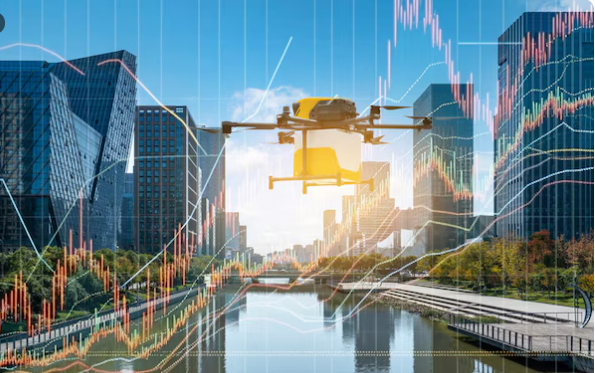

The trading screens flicker with typical volatility as soon as the market starts. Although its ticker has been showing up more regularly on retail investor screens, RCAT isn’t a household name—at least not yet. The stock moves in a definite rhythm, with sudden leaps, short pauses, and then another upward surge. It doesn’t feel totally steady, but it also doesn’t feel coincidental.
Once functioning quietly in the shadows of the drone sector, Red Cat Holdings has suddenly found itself in a considerably brighter limelight. Its shift toward defense and military applications, which carry both opportunity and weight in the current geopolitical environment, accounts for a large portion of that attention. Investors appear to think that drones are evolving from specialized tools to essential infrastructure.
RCAT Stock: A Quiet Drone Company Drawing Loud Market Attention
| Element | Information |
|---|---|
| Company | Red Cat Holdings, Inc. |
| Ticker | RCAT |
| CEO | Jeffrey M. Thompson |
| Headquarters | San Juan, Puerto Rico |
| Founded | 1984 |
| Market Cap | ~$2.03 Billion |
| Industry | Drone Technology & Defense |
| Reference Website |
On the surface, it’s difficult to ignore the numbers. Revenue in Q4 2025 increased by around 2,000% year over year, which usually attracts notice. The $26.2 million in revenue exceeded projections, and that in and of itself has caused opinion to change. However, the company is still losing money, which is an uncomfortable fact. And not just a little bit.
This pattern has a familiar quality. Deep losses, rapid growth. It is reminiscent of earlier stages of businesses like Tesla or even certain SaaS companies during their growth years. However, it’s still unclear if RCAT is aiming for that kind of scale or is only capitalizing on industry enthusiasm.
“How big could this get?” has replaced “What does this company do?” in some investor circles. Usually, that indicates momentum. Price targets have been optimistic, ranging from $21 to $25 in certain situations. The stock is nearing its 52-week high and has recently been trading in the $16–$18 region. There is a certain tension created by that closeness—space to grow, but also room to fall.
A more complex picture emerges when one examines the company’s positioning. Red Cat is more than just a drone manufacturer. It involves assembling hardware, software, and data analytics into a system. Its Dronebox platform, which incorporates blockchain technology to track flight data, seems ambitious. Maybe even a little bit ahead of what the majority of users now comprehend.
Another aspect is added by the interaction with Allen Control Systems. Autonomous capabilities are strategic assets rather than merely technological improvements, especially in defense-related contexts. It’s possible that RCAT is establishing itself at the ideal nexus of timing and technology, given the growing reliance of governments on unmanned systems.
Nevertheless, there is a perception that the market is expanding more quickly than the business. Recent jumps in volume—roughly 31 million shares were exchanged in a single day—indicate increased interest, which may be motivated by both short-term and long-term investors. This combination might be erratic. Momentum develops swiftly. It can vanish equally quickly.
It’s difficult to ignore how closely RCAT’s narrative fits with more general defense trends. Globally, military spending is increasing. Technologies for surveillance and reconnaissance are evolving. Previously connected to enthusiasts or specialized businesses, drones are now a part of strategic planning. Investors appear to be making these connections, maybe a little too quickly.
However, there are still questions. One is profitability. The company’s P/E ratio is negative, indicating continuous losses. That is not out of the ordinary for expanding businesses, but it does pose questions regarding sustainability. Is this rate of revenue increase sustainable? Will investor enthusiasm follow if it slows down?
Additionally, there is the issue of size. There are slightly more than 100 employees at RCAT. For a business with a multibillion dollar market capitalization, that is comparatively tiny. It implies both boundaries and agility. Pressures that aren’t immediately apparent could be introduced by managing contracts, competing with larger defense contractors, and scaling up production.
The RCAT narrative resembles a snapshot of the current market in certain aspects. Overlying uncertainty is optimism. compelling stories backed by specific evidence. a faith in the possibilities of the future, balanced by the facts of the present.
There’s a subtle feeling that RCAT is being tugged in two different directions as this develops. On the one hand, a booming market and real technological advancement. Conversely, investors may already be pricing in unfulfilled outcomes.
Which force will prevail is still up in the air. But for the time being, the stock keeps moving, attracting interest, posing queries, and—possibly most tellingly—keeping investors on the edge of their seats.
