

I recently witnessed a child, with wide eyes, shuffle past the shiny new Polaris suites on a flight from Los Angeles to New York, only to be crammed into a middle seat in row 34, where the overhead bins were already full. That picture stayed with me.
Airlines are redesigning their cabins once more, but the advantages are sharply correlated with cost. Not just for business travelers, but also for wealthy leisure travelers who value comfort over price, premium travel has become the new obsession. As might be expected, airlines are strongly favoring that choice.
| Category | Description |
|---|---|
| Premium Seats | More lie-flat beds, privacy suites, luxury dining added for high-paying flyers |
| Economy Class | Seat count often reduced, tighter spacing, and fewer complimentary amenities |
| Airline Strategy | Increase profitability through high-margin premium offerings |
| Affected Passengers | Budget travelers face diminished comfort; affluent flyers gain exclusivity |
| Hawaii Flights Impact | Slow cabin modernization; lagging behind in premium options |
| Notable Airline Examples | United, Delta, American, Hawaiian (via Alaska integration) |
American, Delta, and United have all been renovating their cabins to add more luxurious seats, some of which have lie-flat beds, sliding privacy doors, and menus prepared by famous chefs. For example, United announced that its premium cabin revenue increased by 5.6% year over year and that it intends to add more than a million premium seats annually.
The analogy to real estate is frequently used. The aircraft itself is fixed space, like an apartment, according to one professor at Embry-Riddle. Five small studio apartments or two opulent penthouses can fit, but not both. It makes sense that airlines are choosing the penthouses. There is a substantial increase in the profit margin.
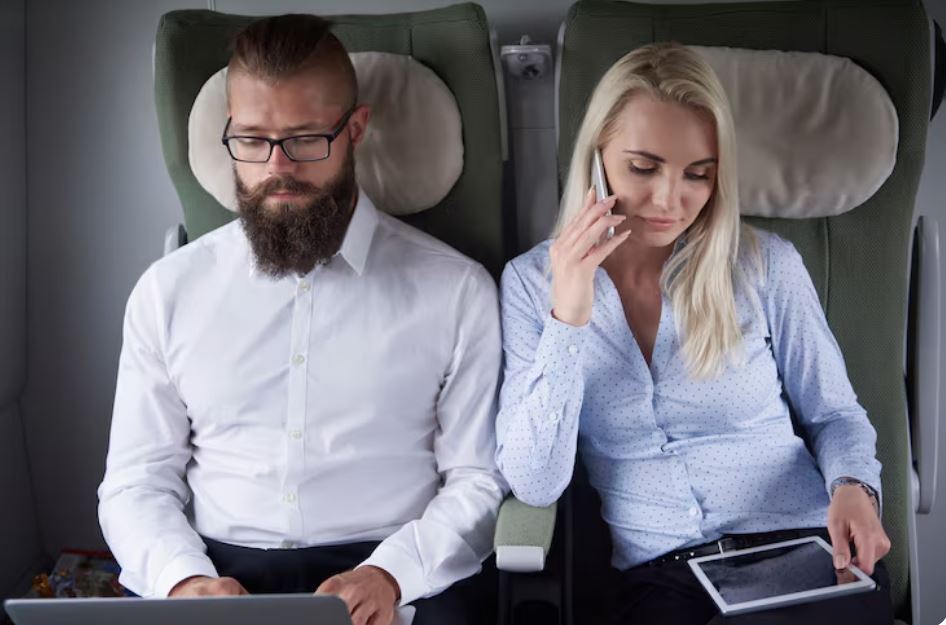
In the meantime, the plane’s rear is silently getting smaller. In dignity, not in presence. Economy seats are still available, but they have a shorter pitch, a stingier recline, and the previously free front-of-cabin legroom is now charged and labeled as “preferred.”
Many tourists grew accustomed to more room and less crowding during the pandemic. However, that fleeting golden age vanished as air traffic started to increase again. Instead, a reformed devotion to comfort—particularly among the wealthy—emerged.
I recall hearing a couple murmur, “We should’ve booked Premium Economy,” as we boarded a flight to Honolulu. This is cruel. Their remorse was remarkably familiar, even though they were going on vacation rather than on business.
Not all flyers are losing out, mind you. The experience is greatly enhanced for those who can afford to indulge. They settle into reclining pods with personal storage, ambient lighting, and a whisper-quiet setting, board early, and sip prosecco prior to takeoff.
This trend is incredibly successful for airlines. In addition to raising prices, it enables them to attract aspirational consumers, who previously would not have paid for business but now do so in order to celebrate milestones, anniversaries, or just for peace of mind.
Hawaiian Airlines provides a warning example. It was once on the verge of taking the lead with its Dreamliner cabins and Leihōkū Suites, but financial strain and delays caused it to fall behind. Only after Qatar Airways beat them to market with the same model did the lie-flat seats finally make their debut. The instant was over.
Hawaiian’s inability to implement a true premium economy was even more obvious. Instead of the middle-tier luxury option that passengers now demand, its “Extra Comfort” product is just an economy seat with more legroom.
Now that Hawaiian has been acquired by Alaska Airlines, a new chapter could start. Alaska has a modest but continuously improving record. With better seat designs, better meals, and more environmentally friendly materials, its First Class has significantly improved. It remains to be seen if that vision holds true for long-haul flights in general and Hawaii in particular.
If the A330 overhaul goes according to plan, it might be the pivotal moment. Alaska may finally bring Hawaii-bound cabins into compliance with international standards by removing up to 60 economy seats to make room for dedicated premium economy. As of right now, many island visitors still characterize the experience as passable rather than exceptional.
International airlines are leading the way elsewhere. With cutting-edge materials, 3D-printed parts, and opulent finishes that are incredibly strong and lightweight, carriers in Europe and Asia are pushing the boundaries and improving passenger satisfaction while reducing fuel consumption.
These initiatives are especially creative. One carrier even completely avoided supply chain delays by using 3D printing to expedite its seatback upgrades. Another used ultra-light footrest sliders, which resulted in a 17% reduction in onboard weight.
In addition to increased ticket sales, airlines also use media attention and customer perception to support these expenditures. Headlines are generated by a sleek new cabin layout. It has the power to persuade a reluctant passenger to pick one airline over another.
A 2024 survey found that the top customer priorities were ease of travel and trust. However, for airlines that received bad press, trust metrics dropped by 400 points. Although they can’t solve every issue, cabin redesigns significantly improve the brand.
Additionally, it promotes recurring business. Uncomfortable flights are not easily forgotten. However, a seamless, cozy, well-lit seat combined with amiable service and a satisfying meal? That also sticks, and it frequently results in loyalty.
However, not everyone gains equally. Flying in basic economy may result in more restrictions, higher overhead bin access fees, and a subtle downgrade in the care hierarchy.
The wealthy, on the other hand, benefit more than just comfort. They become well-known. They are greeted by name by gate agents. Flight attendants are respectful when pouring their drinks. The app experience is also different, providing better customer support, faster service, and more lucid options.
Flying used to be more democratic. when a row 20 seat was only slightly less comfortable than a row 4 seat. It’s obvious that time is over.
And the rest of us are left navigating an increasingly stratified sky somewhere between the disappearing armrests and the branded wine lists.
But maybe that’s what flying is now: a set of decisions shaped by strategy, calibrated by privilege, and presented in mood lighting and brushed aluminum.
I’m not sure when I first noticed, but lately, I’ve noticed that there are more people wearing noise-canceling headphones, fewer conversations in coach, and the quiet resignation of those who realize their space is getting smaller.
