
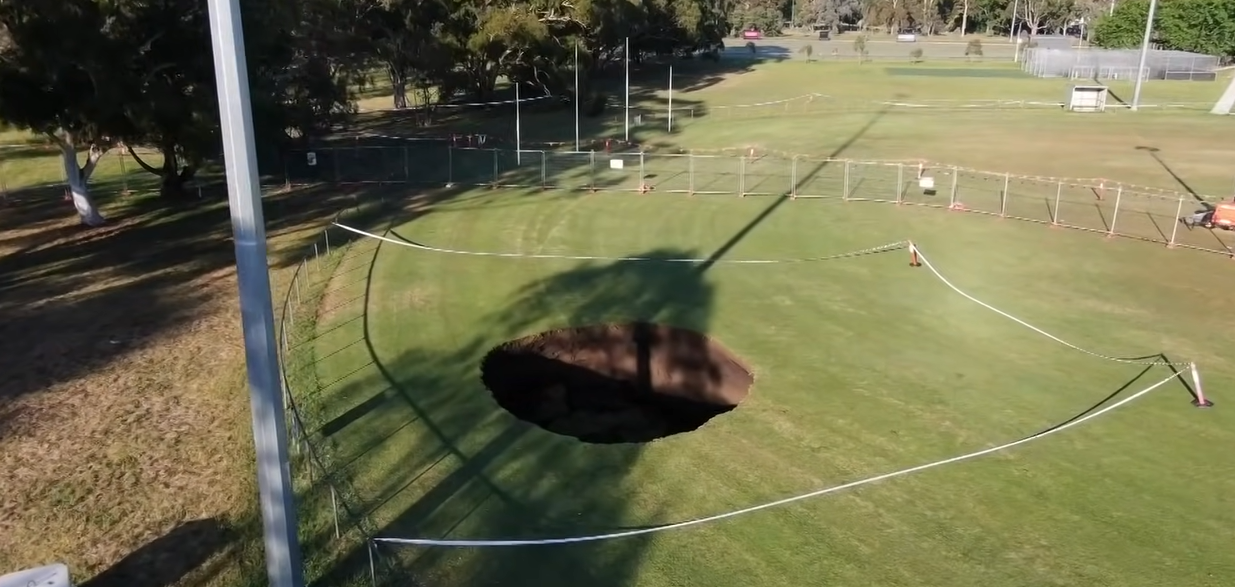

Not only did the turf give way, but a feeling of certainty did as well. Heidelberg’s AJ Burkitt Oval, a small but beloved stadium, unexpectedly developed a hole large enough to cancel weekend games, stall a billion-dollar tunnel, and cause significant public unrest. Approximately ten meters in diameter and five meters deep, the sinkhole did not engulf residences or roads. However, it struck a much bigger symbolic target.
They quickly put up a temporary fence by late Monday afternoon. The police kept watch. Families who had come for a leisurely walk or cricket practice hung around the perimeter, taking pictures in silent shock. Games are typically decided by inches on this field. Meters of ground had vanished completely now.
Why? The review is still ongoing. However, rumors soon moved underground, 45 meters below the surface, where twin tunnel boring machines were laying the foundation for one of Victoria’s most ambitious infrastructure projects: Melbourne’s North East Link. There were additional cases around the country where significant surface disruptions and tunneling projects had coincided, and the correlation was quite similar.
A representative of the project consortium attested that the sinkhole was in fact close to their operations. Tunneling was put on hold. No one was hurt, and there was no damage to any homes. In theory, the reaction was quick and manageable. However, the emotional impact extended beyond the fence line for many people in the neighborhood.
| Detail | Information |
|---|---|
| Location | AJ Burkitt Oval, Heidelberg, Melbourne, VIC |
| Discovered | Monday, January 5, 2026 |
| Estimated Size | 10–12 meters wide, 5 meters deep |
| Proximity to Tunnel Project | ~45 meters above North East Link tunnelling works |
| Responsible Body | Spark Consortium (North East Link Project) |
| Immediate Action Taken | Site cordoned off, tunneling paused, investigation underway |
| Public Advisory | VicEmergency: “Stay away, risk of further collapse” |
| Notable Impact | Community sport disruption, safety concerns, scrutiny of tunneling project |
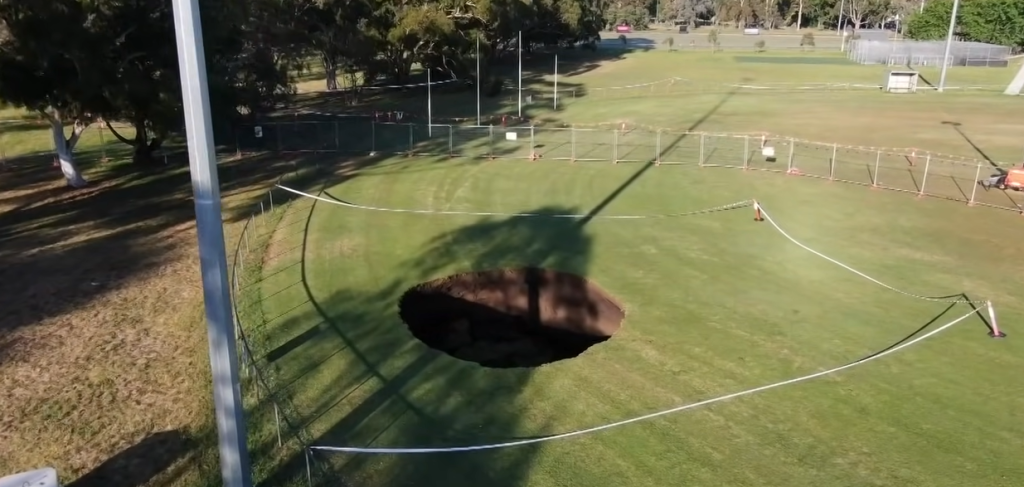
The Banyule Cricket Club president, Brad Bowler, said local families were most affected. He remarked, “We’re used to drainage problems, but not the ground vanishing.” The sinkhole had breached a layer of trust in addition to interfering with training. And what else may move underfoot?
Currently, Spark Consortium, the organization in charge of North East Link, owns the site. They have to manage perception in addition to engineering recovery. This obvious breakdown added intricacy to a project already beset by public scrutiny regarding expenses, environmental effects, and inconveniences.
On the edge of the oval, I recall stopping to see an old man hoist a child up onto his shoulders so he could look inside the walled area. He merely gazed, his brows knitted, without saying anything. Silence speaks louder than anger sometimes.
Sinkholes rarely provide advance warning. They develop silently, frequently as a result of shifting groundwater conditions or deteriorating subsurface layers. The danger compounds are increased when you include the weight and vibration of large boring machines. These are known and modeled issues for engineers, but the results are rarely as obvious to the general public.
This episode is especially troubling because of the location of the void as well as the void itself. This location is neither distant nor industrial. This communal park is surrounded by family residences and is primarily used for hearing rather than seeing drills and other machinery. When an unseen initiative encounters a highly visible breakdown, public trust is put to the test.
Notably, VicEmergency warned that people should avoid the area due to the sinkhole’s propensity to grow. And for good reason—the language was quite clear. Changes in soil can happen at any time. Not merely a decorative element, the fence marked the boundary between potential danger and curiosity.
In response, government representatives insisted that the surrounding infrastructure was not at greater risk. Technically, they were right to reassure. Nonetheless, there were reasonable concerns among locals who lived fewer than 400 meters from the location. Because the incident had been unexpected, people’s perceptions of their surroundings can be altered just once.
Although measured, the community’s reaction has not been passive. Transparency regarding soil stability, drilling depths, and real-time monitoring systems has been demanded by locals. These are not demonstrators who want to obstruct advancement. They are regular people who want to ensure that safety is not sacrificed in the sake of advancement.
But it’s promising that this could be a watershed moment for the way infrastructure is conveyed and incorporated into public life, not only for tunneling supervision. Authorities might create community trust, which is more powerful than tunnels, by using strategic communication and more transparent risk disclosures.
Urban megaprojects frequently take place under a veneer of public indifference until something breaks through. That’s what the Heidelberg sinkhole actually did. What lies underneath, and how can we ensure that it holds? This is the question that engineers, council officials, and residents all have at this point.
One could easily see this as a failure. However, it might turn out to be a surprisingly useful lesson. In addition to being finished, the North East Link may become safer and more intelligent if safeguards are paused, reviewed, and improved. Therefore, this sinkhole is more than simply a setback. It is an occasion to strengthen the foundation upon which we build—and the discourse with which we build.
