
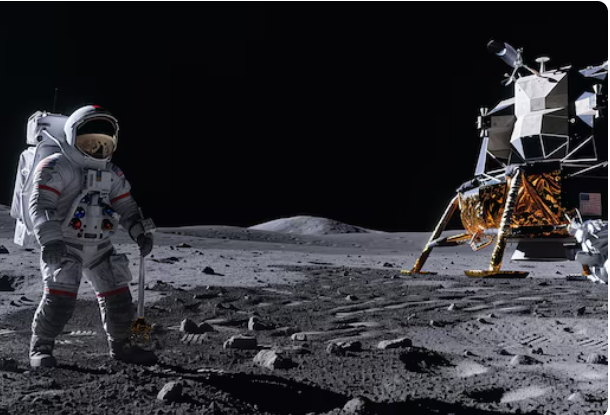

The idea of visiting the moon is no longer unattainable. Rockets take off. The capsules dock. Landing systems get better. The serene assurance with which NASA and private company engineers discuss lunar return missions would have surprised the Apollo generation. However, the true issue starts when you get there.
From a distance, the Moon appears still, a white, quiet globe hovering over the horizon. It’s not dead, though. It breaks. It moves. For hours on end, it trembles. And the greatest underappreciated challenge to the Artemis program’s goal of establishing a long-term human presence there may be that silent instability.
| Category | Details |
|---|---|
| Primary Agency | NASA |
| Program Context | Artemis program |
| Key Hazard | Moonquakes (deep and shallow seismic activity) |
| Temperature Range | +120°C (day) to −180°C (night) |
| Radiation Exposure | 200–1,000x higher than Earth’s surface |
| Proposed Solution | Underground habitats in lunar lava tubes |
| Reference | https://www.nasa.gov |
Unlike earthquakes on Earth, moonquakes are not as dramatic. There are no trees swinging in the breeze or booming environment. However, shallow moonquakes have the potential to be strong enough to endanger buildings. The Moon doesn’t have an atmosphere or a lot of water, therefore vibrations don’t go away right away. Hours of tremors can gradually stress materials.
Because they didn’t stay long enough, brief Apollo missions might have averted serious problems. The statistical probability of experiencing a significant seismic event is increased with a lunar basis that lasts ten years. According to some estimates, the risk is about 1 in 5,500 during a ten-year period. The odds are not disastrous. However, it’s also not insignificant.
Imagine a module of habitat sitting on the regolith. Temperature swings from 120 degrees Celsius during the day to minus 180 degrees at night cause metal joints to tighten and loosen. over two weeks of darkness on Earth. Then the sun was blinding for two weeks. Few terrestrial buildings could withstand the continuous expansion and contraction that would put composite panels, fasteners, and seals to the test.
Those temperature extremes have an unnerving quality. Even arid deserts on Earth cool down with time. Thermal cycling is sudden and unrelenting on the Moon. fatigue of materials. Microscopic fissures expand. That matters in the long run.
Another layer of exposure is added by radiation. High-energy particles are immediately absorbed by the lunar surface in the absence of an atmosphere or magnetic field. The amount of radiation can be hundreds of times higher than what is found on Earth. Heavy shielding would be necessary for astronauts working outside of habitats. Any long-term power systems, such as nuclear units under consideration for continuous operations, would also do this.
There is no soft sand in lunar regolith. It is the result of meteorite impacts that have been crushed into tiny, sharp pieces over billions of years. The particles are electrostatically charged, abrasive, and sharp. Astronauts on Apollo missions characterized it as obstinately adhering to gear and suits. It deteriorated mechanisms by infiltrating hinges and seals. It’s difficult to avoid picturing that same dust progressively wearing out moving parts in construction equipment of the future.
There, even simple mechanics act differently. Cold welding is the technique by which clean metal surfaces forced together can fuse in the vacuum of space. This is not possible on Earth due to air and thin oxide coatings. Two untreated surfaces on the Moon could form a permanent bond. Unexpectedly, moving parts could seize.
A paradox is also introduced by gravity, which is one-sixth of Earth’s. Materials are easier to lift since they weigh less. However, they are more difficult to manage. When heavy equipment presses up against the ground, it runs the risk of pushing backward instead. Anchoring excavators and drills turns into a separate engineering conundrum.
It seems as though the visual blurs these complexities when one views models of sleek lunar dwellings that gleam subtly against the gloomy horizon. Policymakers and investors discuss permanent settlements as though launch costs were the only obstacle. However, the Moon itself could not cooperate as expected.
According to some scientists, the safest option is underground. Lava tubes, which are enormous hollow passageways that may be big enough to contain entire bases, were formed beneath the lunar surface by ancient volcanic activity. Habitats would be protected from radiation, micrometeoroids, and temperature fluctuations beneath several meters of rock.
There are several candidates in the Mare Tranquillitatis region, which was the location of Apollo 11’s landing. It seems lyrical in its own right to imagine people going back there—not to plant flags, but to vanish beneath the surface.
Human habitation will probably come after robotic construction. Before astronauts arrive, autonomous systems are assembling pressurized chambers while working in the radiation and dust. How rapidly and reliably such technology can be scaled is currently unknown.
The act of spaceflight itself is becoming more commonplace. Boosters that can be reused land upright. Launch windows are planned months ahead of time. However, it takes humility, redundancy, and patience to construct securely on an active moon.
The Moon is more than just a blank canvas waiting for progress. It is a hostile, dynamic environment that suddenly heats, moves, freezes, and bombards. Perhaps the most significant insight now emerging in mission planning rooms is that reaching the Moon is not the difficult part.
