
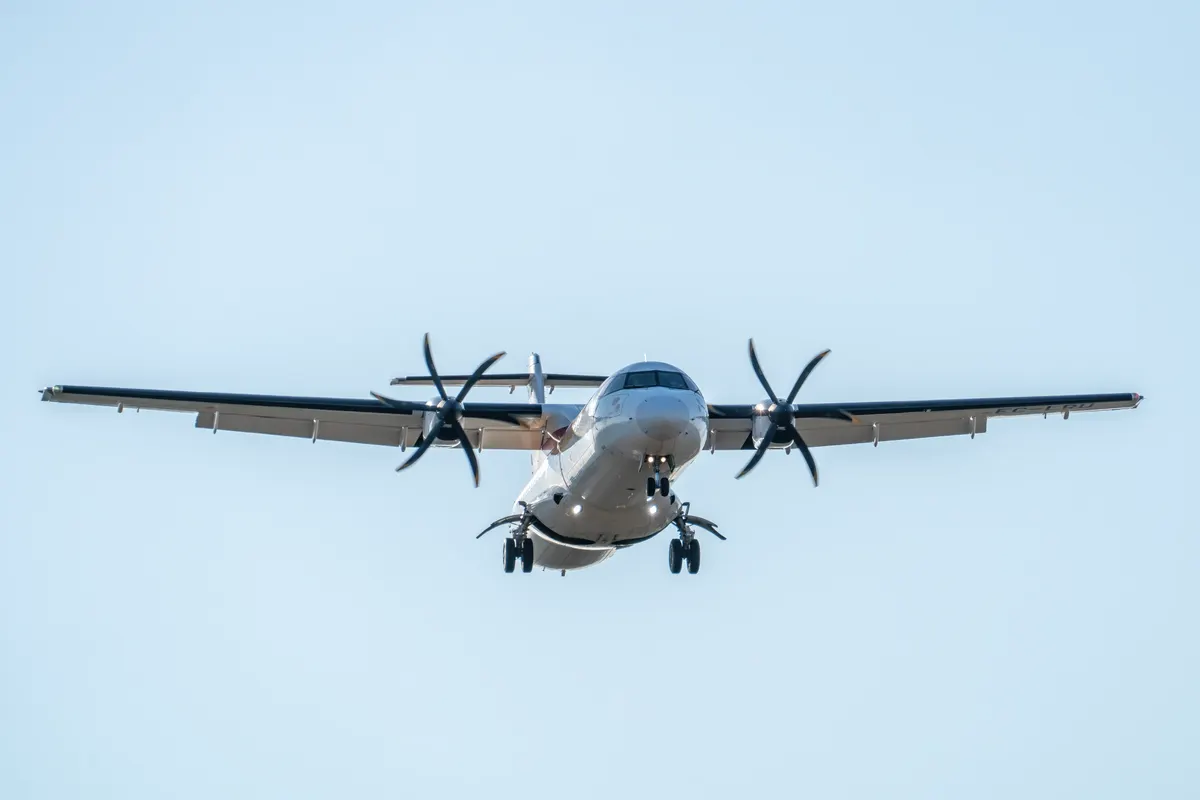

ATR‘s analysis of ATR Indonesian turboprop routes has identified 209 domestic corridors that could be served viably by regional aircraft, pointing to a market of roughly 16 million passengers a year that currently moves by road, ferry or not at all.
The Franco-Italian turboprop manufacturer derived those figures from its proprietary MobilityMonitor platform, which tracked the inter-city travel behaviour of 35 million Indonesian residents over the course of a year. That sample recorded approximately 780 million journeys made by car, motorbike, bus, ferry, train and plane. Around 90% of those trips fell within the 100-to-800-kilometre band that ATR says suits turboprop operations.
Seventy airports, no scheduled service
Central to ATR’s case is the state of Indonesia’s existing airport network. Of the country’s 180 paved-runway airports, 70 currently carry no scheduled passenger service at all. By cross-referencing the most common travel corridors with that dormant infrastructure and then scaling the sample to estimate total market size, ATR arrived at its list of 209 potential routes, arguing that most could be opened without material new investment in ground infrastructure.
Eighty-eight per cent of the identified routes (representing around 14 million passengers annually) are intra-island connections rather than inter-island links. Ninety per cent of the routes fall on islands other than Java, covering Sumatra, Sulawesi, Kalimantan, Papua and Maluku.
Infrastructure gap drives the ATR Indonesian turboprop routes opportunity
The distribution reflects a well-documented imbalance in Indonesian surface infrastructure. Java accounts for roughly 7% of the country’s land area but holds approximately 58% of its motorway network. Kalimantan is around four times larger than Java yet has only about 5% of national motorway coverage. That disparity translates directly into journey times: average surface travel speeds in Java reach around 65 kilometres per hour, while elsewhere in the archipelago speeds drop to between 26 and 37 kilometres per hour. On the outer islands, distances between urban centres tend to exceed 350 kilometres and reach nearly 480 kilometres in parts of Papua.
ATR identified Sumatra and Sulawesi as the two largest individual market opportunities, citing strong travel demand across a wide spread of city pairs. The company used the Bengkulu-Pekanbaru corridor in Sumatra as an illustration: a surface journey between the two cities can take more than 18 hours, against roughly one hour by direct flight. ATR estimates demand on that corridor could support two daily flights.
The commercial argument
Alexis Vidal, ATR’s Senior Vice-President, Commercial, said the data supported a clear case for regional air services. ‘The demand is there, as is the airport infrastructure. What is needed now is the right aircraft,’ Vidal said. He added that MobilityMonitor had revealed how uneven mobility is across the archipelago and argued that scheduled regional services could begin to close that gap. ‘By connecting communities across the archipelago using regional air services, it will help to drive economic growth, provide greater access to essential services and create more opportunities for people,’ Vidal said.
The findings land at a moment of broader industry focus on regional connectivity. IATA has consistently flagged underserved domestic markets in Southeast Asia as a structural growth area for aviation, with short-haul turboprop operations positioned as an economically efficient entry point where jet operations cannot break even at low frequencies.
For Indonesian policymakers and carriers, ATR’s data points to a specific next step: the Indonesian Ministry of Transportation oversees licensing for domestic scheduled routes, and ATR’s list of 209 corridors represents a ready-made pipeline for any operator willing to put a regional aircraft into those dormant airports.
