
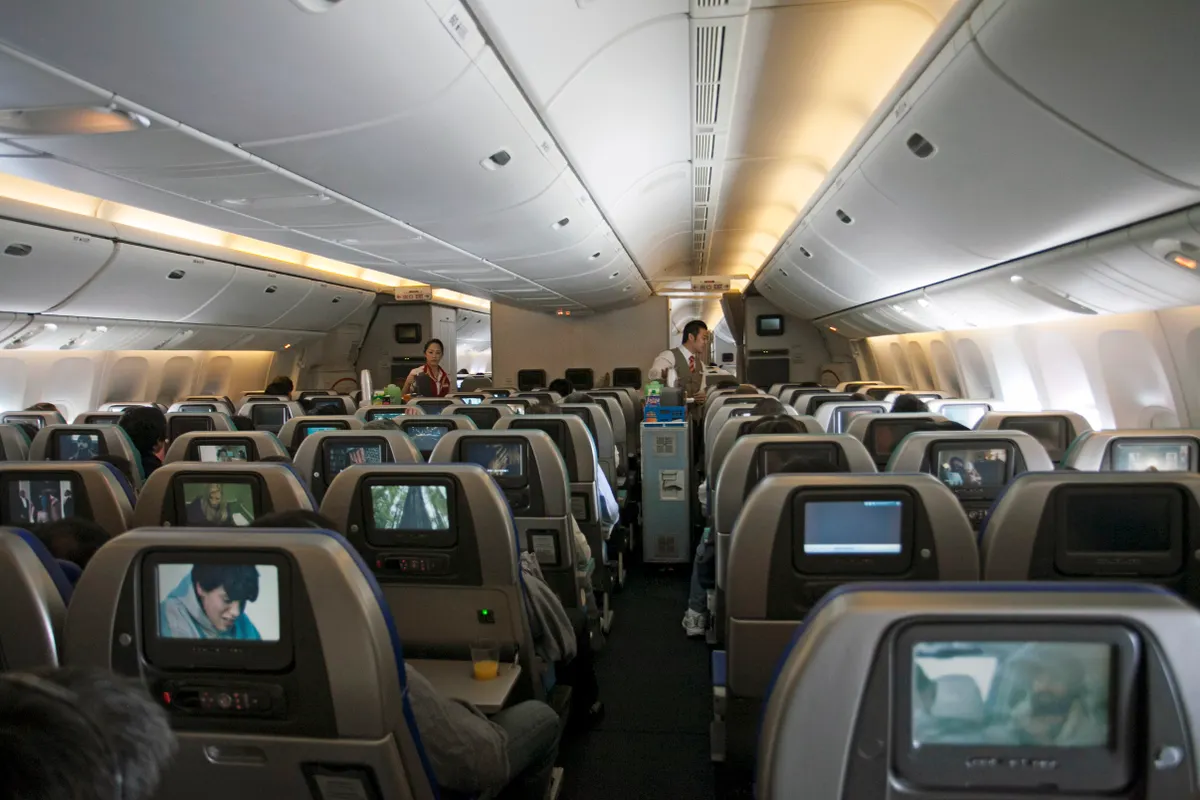

The United Airlines headphones rule faced one of its more visible tests on 19 August, when crew aboard flight UA1488 from Chicago O’Hare to Cleveland came close to returning to the gate after a passenger repeatedly refused to use headphones while watching a video at high volume.
Rule 21 and the United Airlines headphones rule
United Airlines updated its contract of carriage on 27 February 2026, adding mandatory headphone use to Rule 21. The updated rule states that removal of a passenger may be necessary where they ‘fail to use headphones while listening to audio or video content.’ The policy applies across all United flights and has since been enforced on multiple occasions, with this week’s Chicago-to-Cleveland incident drawing fresh attention online.
Delta Air Lines has not yet implemented a comparable headphones-only requirement, leaving United as the carrier most visibly associated with the policy. United’s willingness to enforce it (up to and including the threat of diversion) is being watched closely across the industry as other carriers consider whether to follow.
Crew intervention on flight UA1488
Flight UA1488 departed Chicago O’Hare on the morning of 19 August. According to a passenger who documented events in a public post, the trouble began when a traveller in seat 22F played a film at high volume without headphones. Fellow passengers asked him to lower or cut the sound. He refused. Two flight attendants then intervened separately, and the captain made a public address announcement, still to no effect.
‘Shout out to the great job by the FA’s on this morning’s Chicago to Cleveland (UA1488) flight,’ the witnessing passenger wrote. ‘Guy in 22F playing his movie or whatever at high volume. We asked him to turn it down or off, it finally took 2 FA’s and the captain making an announcement to get him to turn it off.’
Threats to return to the gate and remove the passenger were issued. The passenger’s reported responses during the exchange included: ‘You got AirPods I can use? I’ll give them back’, ‘I ain’t bothering no one’, and ‘since when do I need headphones on an airplane?’ The flight nevertheless continued to Cleveland, landing at 9:40am.
The passenger eventually silenced the film after crew cited FAA requirements. However, he then made a phone call, which falls under a separate prohibition in Rule 21 covering voice and video calls during flight. The witnessing passenger noted: ‘After 2 FA’s and the pilot on the PA informed him of the FAA’s requirements, he silenced his movie. Then made a phone call. We still took off, and the flight was mostly uneventful. Upon landing, he made another phone call.’
Gate agent and police involvement after landing
The disruption continued on the ground at Cleveland. The passenger in question allegedly photographed the family who had reported him during the flight, and both parties spoke with a gate agent on arrival. ‘When we got to the gate, he popped up and made sure to take photos of me and my family on his way out,’ the witnessing passenger wrote. ‘We spoke to the FA’s on the way out, and they suggested we speak to the gate agent.’
A supervisor handled the post-flight exchanges and, according to the account, told the family that similar incidents occur ‘several times a day, every day.’ An airport security guard and two Cleveland police officers arrived before the parties left. The supervisor was described as cooperative throughout.
Reaction online ran heavily against the non-compliant passenger. Commenters drew on their own experience of passengers playing audio without headphones, with one account describing a couple watching TikTok videos at full volume at a gate, oblivious to those around them. Several responses referenced the broader issue of situational awareness in shared cabin spaces, with one commenter noting: ‘He’s acting exactly like what I’d expect from an adult who has never flown.’
For United’s operations teams, the UA1488 incident is likely to serve as a reference point. Concerns had circulated since the February rule update that enforcement on board would be inconsistent or that crew would be reluctant to escalate. The crew’s conduct on this service, from the initial warning through to captain involvement and the threat of diversion, suggests the carrier is treating Rule 21 as an operational standard rather than an advisory, with the gate agent and police presence at Cleveland indicating the policy has ground-side backing as well.
