
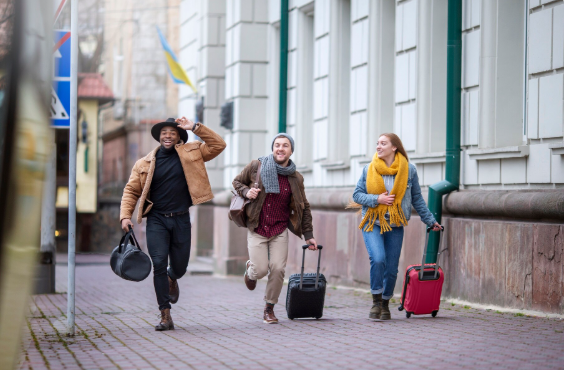

Departure boards at Toronto Pearson International Airport display a subtle yet telling image. Although flights continue to depart for Paris and Tokyo, domestic routes to Calgary, Halifax, and Kelowna appear to be remarkably prevalent. Families congregate close to the boarding gates, comparing itineraries that have multiple stops. Although it isn’t noticeable or dramatic, Canadians are increasingly traveling to multiple cities.
In 2025, Canadians made over 90 million domestic travels in a single quarter, setting new records for domestic travel. Travelers carry multiple boarding passes as they navigate airport terminals. Vacations seem to be evolving into series rather than one-off getaways, taking place across provinces rather than coming to an end in one location. This change feels economic in part.
Canadian Multi-City Travel Trends Snapshot
| Category | Details |
|---|---|
| Trend | Increase in Multi-City and Multi-Stop Domestic Travel |
| Record Domestic Trips | 90.6 million trips in Q2 2025 |
| Decline in U.S. Travel | Down 21.6% in Q2 2025 |
| Domestic Travel Spending | $20.3 billion in Q2 2025 |
| Key Cities | Toronto, Montreal, Vancouver, Kelowna |
| Fast-Growing Provinces | Prince Edward Island, Saskatchewan, Newfoundland |
| Travel Motivation | Value, cultural exploration, economic factors |
| Reference |
Travel math has been subtly altered by the Canadian dollar’s decline versus other major currencies. Even when ticket prices seem reasonable, flying to the US or Europe suddenly feels more expensive. Booking several Canadian cities rather than a single far-off location suggests that travelers feel their money goes farther at home.
Road trips are also included. Rental cars loaded with bags travel steadily between Banff, Jasper, and smaller towns on highways that cut through the Canadian Rockies. Gas stations are bustling, their parking lots full of cars with British Columbian, Ontario, and Quebec license plates. These tourists might be looking for more than just scenery. They are looking for diversity. Once a default choice, travel to the United States has drastically decreased.
In 2025, travel south of the border decreased by over 20 percent. Exchange rates, changing perceptions, and economic tensions all appear to be factors. Passport lines at border crossings seem shorter than they used to be. It seems as though Canada itself has taken on the role of the destination.
Hotel lobbies in Montreal are crowded with multilingual tourists, some from Toronto, others traveling to Quebec City or the Atlantic coast. Their itinerary seems well-thought-out and multi-layered. Whether this pattern represents a more profound cultural shift or transient economics is still unknown.
However, the emotional center is found in nature. With its quiet roads and red sand beaches, Prince Edward Island has experienced incredible growth. Slow-moving tourists stop often, take pictures, and stay longer. Canadians seem to be rediscovering their own geography, as though they are seeing it for the first time.
Airlines are making careful adjustments. Instead of passing through major hubs to connect smaller cities, carriers are growing their regional routes. Although profitability is uncertain if economic conditions change, investors appear to think that this decentralized model could create consistent demand.
The trend is supported by spending trends. In one quarter, Canadians spent more than $20 billion on domestic travel. Even outside of customary peak seasons, local tour operators, hotels, and restaurants report consistent business. Seeing the number of restaurant patios in places like Kelowna makes it evident how tourism generates income outside of major cities.
Additionally, there is a psychological component. There seems to be less interest in hurrying among travelers. They make several shorter journeys, progressively connecting locations, as opposed to a single, long journey. This slower tempo implies a shift in priorities and a preference for experience over distance.
Travel apps facilitate the booking of multi-city itineraries by enabling instantaneous route and price comparisons. Because of the removal of obstacles that once kept travel straightforward and linear, planning feels less difficult than it used to.
One gets the impression from watching this develop that travel to Canada has become more reflective. Travelers are looking across their own vast landscape rather than outward.
Exchange rates change over time. Economic conditions change over time. If financial strains subside, international travel might become more popular again. However, once established, habits seldom go away quickly. In highways, trains, and airports, Canadians keep traveling—not so much, but more widely.
