
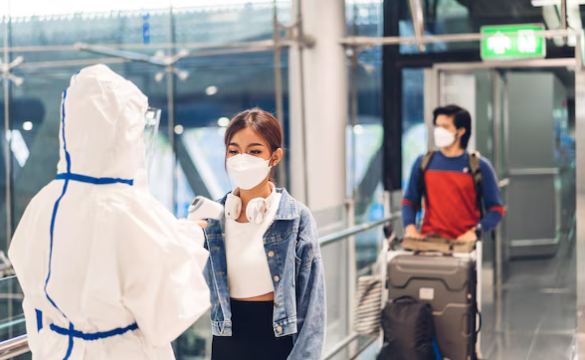

Airports are designed to accommodate travel. Rolling suitcases on gleaming floors. Calls to board reverberate off of steel and glass. Families congregating close to charging outlets while being partially distracted by travel information. However, for a few peaceful hours on February 12 within Philadelphia International Airport’s Terminal E, movement conveyed something else.
Later, health officials verified that between 1:35 and 4:30 p.m., a measles-infected individual had entered the terminal. The same airspace may have been traversed by thousands of passengers. After an infected individual leaves, the virus, which is patient and invisible, can remain in the air for up to two hours. Handshakes are not necessary. It doesn’t require closeness. All it needs is breath.
| Category | Details |
|---|---|
| Disease | Measles |
| Location of Exposure | Philadelphia International Airport |
| Confirmed Exposure Date | February 12 (Terminal E, 1:35pm–4:30pm ET) |
| Reported by | Philadelphia Department of Public Health |
| National Health Authority | Centers for Disease Control and Prevention |
| MMR Vaccine Effectiveness | ~97% after two doses |
| Reference |
The Philadelphia Department of Public Health’s Dr. Palak Raval-Nelson used cautious wording. She stated that it was thought that there was little risk to the public. But the warning was serious. Up to 90,000 travelers pass through Philadelphia International every day. That is a sizable potential exposure pool.
It’s not subtle, measles. Fever and coughing are the first symptoms, followed by a blotchy rash that starts at the hairline and spreads lower. Tiny white Koplik marks show up inside the mouth like a silent signature. However, the contagious phase has already started by the time the rash appears. Four days prior to the full manifestation of symptoms, patients can transfer the virus.
That timing has an unnerving quality to it. Airports serve as transitional areas between locations. Distracted and exhausted, travelers are rushing through security checks and looking at departure boards. It’s possible that the infected person thought the early symptoms were just travel fatigue and felt only slightly ill. However, measles rarely has modest side effects.
The numbers have been gradually rising across the country. The majority of the more than 800 measles cases documented in 2026, up of mid-February, have been in South Carolina. Since October, there have been around 950 cases reported there, with Spartanburg County accounting for the majority of these cases. It’s like watching embers rekindle after a lengthy period of slumber as the outbreak spreads on epidemiological maps.
After receiving two doses, the vaccination offers approximately 97% protection. That statistic is frequently, and occasionally nonchalantly, repeated. However, the disparity between vaccination rates of 88 percent and 95 percent, as observed in certain localities, is not insignificant. High participation is necessary for herd immunity. Outbreaks are given breathing room after coverage falls below that level.
Clusters of measles have emerged in Lancaster County, Pennsylvania, where kindergarten vaccination rates are approximately 88.5 percent. The bustle of an airport terminal is a great cry from the county’s little towns and country roads. However, enclosed areas and shared air are vulnerabilities that both ecosystems share.
Prior to entering the bloodstream through lymph nodes, measles initially infiltrates the respiratory system. It causes pneumonia in about 6% of children who are otherwise healthy. In rare instances—roughly one in 1,000—it results in brain swelling, or encephalitis. Up to 20% of individuals who get it end up permanently damaged neurologically. Millions of people died from measles every year before vaccines became widely available in the 1960s.
Days after the warning, I’m standing at Terminal E and nothing seems out of the ordinary. The gate announcements go on. Coffee cafes are busy. No obvious evidence of viral drift is present. The unsettling aspect is that. Barricades and sirens are not used to identify the battlefield. It is characterized by airflow.
This exposure might not result in a significant cluster. Health officials are tracking down contacts and advising those who have not received the vaccination to keep an eye on their symptoms. Vaccination is still emphasized by the CDC, particularly for foreign visitors. Outbreaks are occurring in many nations, raising the possibility of cases linked to travel.
This has a deeper undercurrent that seems more cultural and less medical. Whether as a result of shifting trust or disruptions in access, vaccination rates declined throughout the epidemic years. Global mobility now intersects with that hesitancy. In a matter of hours, flights link communities. Viruses travel equally fast.
One gets the impression that public health works in cycles as you watch things play out. In the United States, measles was deemed eradicated in 2000, indicating that ongoing transmission had ceased. Eradication is not the same as elimination. The virus can reappear as long as it is present elsewhere.
Airports increase convenience and danger. They stand for transparency and interconnectedness. Recycled air in enclosed terminals, however, smells more than jet fuel and pretzels. It has potential, both positive and negative.
Whether the publicity from Philadelphia will spread elsewhere is still unknown. It’s possible that most people who went through Terminal E were protected and vaccinated. This might continue to be a confined occurrence. However, the fact that measles is returning—quietly, rapidly—indicates that we need to be vigilant as we travel.
Ordinary motion, rather than anarchy, turned the airport into a battlefield. Rolling suitcases. Aircraft are taking off. Humans are breathing.
