
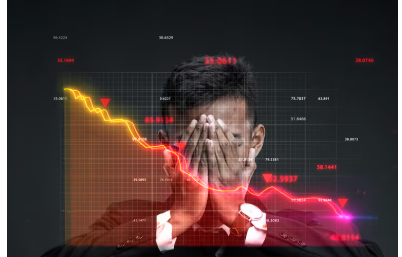

Panic in today’s stock market doesn’t necessarily start with individuals. Code is sometimes the first step. A modest but frightening pattern flickered across Wall Street screens on a recent trading morning. Stocks began to decline, albeit slowly at first. Traders leaned forward in their chairs, checking news feeds, examining financial screens for explanations. The slide then picked up speed. In a matter of minutes, the S&P 500 had fallen more than one percent, and technology shares were plummeting.
Strangely, neither a geopolitical shock nor an economic report served as the catalyst. The essay was speculative. The article, which describes a hypothetical future in which artificial intelligence agents disrupt everything from employment to mortgage markets, originated from a rather obscure research site. It is a “scenario, not a prediction,” according to the authors. However, markets hardly ever stop to consider subtleties.
Key Information About Algorithmic Market Feedback Loops
| Category | Information |
|---|---|
| Phenomenon | Algorithmic trading feedback loops triggering rapid market declines |
| Trigger Example | Viral AI-economic collapse scenario from Citrini Research |
| Market Impact | Temporary selloffs and flash-crash-like volatility |
| Major Index Affected | S&P 500 |
| Key Companies Mentioned in Market Reaction | Uber, American Express, Mastercard, DoorDash |
| Market Mechanism | High-frequency and algorithmic trading systems reacting to sentiment signals |
| Typical Result | Rapid selling, volatility spikes, short-term flash crashes |
| Reference Website |
Algorithmic systems started responding almost immediately as the report circulated on social media and trading floors. The sentiment signals became negative. Models of risk were modified. Selling started. Additionally, the reaction began to feed itself because machines dominate modern markets and trade with other machines. Watching this unfold, there’s a curious sense that the market has become less like a marketplace and more like a neurological system—one where signals move quicker than thinking.
Nowadays, the majority of activity in the US equity markets is algorithmic trading. These systems examine massive data sources, including price changes, volatility indicators, headlines, and even internet conversations. The programs automatically buy or sell in milliseconds when a sufficient number of signals indicate in the same direction. Liquidity is typically provided by that speed. Sometimes, though, it produces something very different: a feedback loop.
The chain reaction in this episode felt virtually textbook. The AI scenario predicted that autonomous software agents would cause a future economic catastrophe. Online, the tale became well-known and propagated through channels for financial discussion. The increase in negative sentiment was taken as a warning by algorithms detecting those signals.
Other algorithms—systems intended to reduce risk when volatility spikes—joined in when prices dropped. Certain funds employ momentum techniques, which enhance moves that might otherwise fade by automatically following downward trends. In a matter of hours, what had started off as a slight decline became a dramatic one.
The impact was immediately felt by a number of the companies listed in the speculative report. During the selloff, shares of DoorDash, American Express, Uber, and Mastercard all experienced significant declines. That day, none of the companies had disclosed any concerning financial information. The majority of their relationship to the downturn was narrative. On the other hand, markets frequently exchange stories.
It’s easy to write off the entire incident as overreacting, and in many respects, it most likely was. The study note itself was not so much about financial analysis as it was about speculative fantasy. It envisioned a near future in which millions of jobs will be lost to AI agents, causing societal unrest and upsetting the credit markets. Even the authors appeared to be aware that the scenario was on the verge of dystopian fiction.
However, markets have always been oddly impacted by speculation. Investors respond not simply to facts but to stories about the future. Prices can change when a sufficient number of players begin to envision the same result, regardless of how improbable. Traders used to discuss such a situation over lunch before making cautious wagers decades ago. The headlines are now parsed by algorithms in milliseconds. Human doubt frequently shows up too late.
The selloff was characterized by analysts as a “micro flash crash,” which is a well-known phenomenon. The occurrence is reminiscent to the notorious 2010 Flash Crash, in which American markets fell by almost 10% in a matter of minutes before rising again. The speed at which algorithmic interactions went out of control at the time astounded regulators.
After more than ten years, markets have added safeguards and circuit breakers to prevent catastrophic failures. These safeguards are beneficial. However, smaller cascades caused by machine-to-machine reactions are not eliminated by them.
These episodes also have a cultural component. Dramatic forecasts are being amplified more and more by social media and financial media. Because they capitalize on real anxiety about the future, doom scenarios—particularly those involving artificial intelligence—spread swiftly.
Such stories were recently referred to as “doomsday porn” by a Saxo Capital Markets analyst. Although the statement sounds crass, there is some truth to it. Markets are influenced by attention, which is drawn to extreme forecasts.
If automated systems disregarded speculative comments, all of this might be irrelevant. However, large streams of sentiment data are incorporated into modern trading models, making it challenging to discern between serious analysis and creative narrative.
The cycle goes on as follows: a story incites dread, algorithms identify fear, markets decline, and the declining market validates the fear. It’s difficult to ignore how little friction still exists in financial institutions that were formerly ruled by human hesitancy as you see the cycle repeat. Once-minute decisions are now made in a matter of seconds.
Ironically, artificial intelligence, the technology that is purportedly creating economic fear, is also influencing the mechanisms of market panic. It’s unclear if authorities will eventually place more stringent restrictions on computerized trading. For the time being, markets are content to coexist with sporadic outbursts of pandemonium. They bounce back fast. Investors move on.
Even still, incidents like this raise unanswered questions. What happens when the next news isn’t speculative, given how easily markets may spin out of control due to speculation?
