

The Knolton Farmhouse Cheese narrative isn’t exactly what most people think of when they hear the term “farmhouse cheese.” Wax-wrapped wheels sold at deli counters, careful aging in stone cellars, and the kind of romantic British dairy narrative that has established reputations for establishments like Neal’s Yard or Montgomery’s Cheddar are all suggested by the framing, which depicts a small artisan business making limited-batch cheese for the local farmers’ market crowd.
Knolton occupies a distinct area. The third-generation family-run company is located in Overton, North Wales, close to Wrexham. Its main activity is processing dairy ingredients in bulk, with its products ending up in trading partner warehouses all over the world. Instead of the small-scale artisan stance that the term has come to suggest in contemporary culinary culture, the “farmhouse” in the name symbolizes the company’s family origins and farm-based history.
| Knolton Farmhouse Cheese — Key Information | Details |
|---|---|
| Business Type | Third-generation family-run dairy |
| Headquarters | Overton, Wrexham, North Wales |
| Full Address | Overton, Wrexham LL13 0LG |
| Country | United Kingdom |
| Primary Business | Bulk dairy ingredient processing |
| Export Reach | Worldwide trading partners |
| Product Range | Cheese, butter, cream, dairy concentrates, powders |
| Local Sales Offering | Cheese and butter at the farm |
| Distinctive Feature | On-site cheese vending machine |
| Phone | +44 1978 710221 |
| Operating Days | Monday through Friday |
| Operating Hours | 8 AM to 4 PM |
| Closed | Saturday and Sunday |
| Region | Wrexham, North Wales |
| Industry Reference | Dairy UK |
The operation’s size reflects a particular aspect of how the British dairy sector has changed over the last few decades. Though it represents a tiny portion of the real dairy sector, the idealized picture of small-cheesemaker Britain—twelve in Cornwall and fifteen in the Yorkshire Dales, each making a few wheels a week for discriminating fishmongers—remains.
The majority of British milk is processed on a large scale to create bulk ingredients that are used in global supply chains. cheese shipped to retail marketplaces in Asia. mixed cream powders used in commercial baking. concentrates that vanish into the production of food on other countries. Knolton works in this sector, doing the unglamorous but actually significant task of transforming raw milk from the nearby agricultural region of North Wales into ingredient items that are essential to global consumers.
The aspect of Knolton’s narrative that sets it apart from purely industrial rivals is the third-generation framing. The company has been in the same family long enough that institutional memory now spans several decades of changes in British agriculture, including Brexit, changes in international dairy demand, changes in British milk pricing, and EU membership and beyond. Dairy processing is an industry that is difficult for new competitors to enter, so consistency is important.
The amount of capital needed is significant. The regulatory environment is strict. It takes years, not months, to establish supply ties with farms and business partners. A three-generation family business has the kind of relationship infrastructure and operational understanding that sets it apart from both larger purely-industrial rivals and smaller craft competitors.
The business’s local services division is what gives Knolton its subtly unique character. Instead of sending all of its production through foreign trading partners, the company retains a small portion of its cheese and butter to sell locally. One of the more talked-about aspects of the business is the on-site cheese vending machine—yes, a real vending machine that sells regional cheese. Clients arrive at the location, choose from the cheese alternatives, pay with the machine, and leave with farmhouse cheese that was made just a few feet away.
A particular aspect of contemporary rural business in Britain is captured by the arrangement. Traditional farmers’ markets are still significant. Farm sales to consumers directly continue to be significant. However, one of the more intriguing improvements in how small farm companies may benefit their local communities is the vending machine concept, which is automated, frictionless, and available after manned hours.
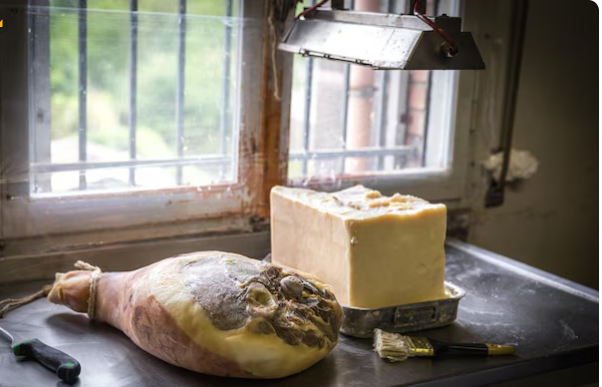
For dairy operations, geographic position is more important than location alone. Situated on the outskirts of one of the most productive dairy producing districts in Britain, Wrexham is located in North Wales. For generations, the nation that borders Wales and Cheshire has produced cheese and milk. The type of grass-fed dairy ingredients that foreign consumers are increasingly demanding are produced by the undulating grassland, the temperate temperature, and the comparatively lengthy grazing season.
Knolton is integrated into this agricultural infrastructure due to its position. The company does not procure milk from distant locations for processing at a central facility. In an area where dairy customs date back many generations before the Knolton family business was established, it is processing milk that is essentially produced in its own backyard.
Walking around the Overton farm on a working day and observing the operations at their leisurely Welsh pace gives me the impression that Knolton reflects a particular aspect of what real family-run agricultural companies look like in 2026. Not the industrial mass-market dairy that characterizes the majority of British supply. Not the romantic small-batch artisan business that predominates in media depiction of food.
Something in between: a significant, well-established processor that has grown to serve global markets while maintaining the local-community bond through direct sales from vending machines, small-batch retail, and the kind of physical presence in the neighborhood that only industrial operators are unable to maintain.
Questions like price, regulations, international commerce, and how the Knolton family chooses to handle the next generational shift will determine whether the larger dairy sector supports this middle-tier model going forward. Meanwhile, the current operation continues to do what it has been doing for the past three generations: quietly, consistently, and with the kind of local roots that are significant to the agricultural region that has been established around them but are not displayed on supermarket cheese counters.
