

Just after nightfall, a certain silence descends upon Grey County. It’s the kind of silence that alerts you to the sound of gravel crunching beneath tires, the far-off hum of a generator, and the gentle glimmer of candlelight streaming from a remodeled farmhouse window. This quiet is shattered on Friday and Saturday nights—and occasionally even on Thursdays—by the arrival of visitors who have driven from Toronto, Hamilton, and sometimes even farther, following GPS directions down a rural line road to a location known as Down Home.
It’s not the type of eatery you find by accident. Neither a busy street corner nor a neon sign are present. Just a farmhouse, a garden, and the conviction that Ontario’s rural areas have tales to share via cuisine.
| Category | Details |
|---|---|
| Restaurant Name | Down Home Farmhouse Restaurant |
| Location | 135299 9 Line, Markdale, Ontario N0C 1H0, Canada |
| Region | Grey County, Ontario |
| Cuisine Type | Farm-to-Table, Seasonal Tasting Menu |
| Dining Style | 10-Course Collaborative Tasting Experience |
| Operating Days | Thursday, Friday & Saturday (one seating per evening) |
| Seating Time | 6:30 PM |
| Duration | Approximately 3 to 3.5 hours |
| Price Per Person | $190 CAD (meal only; beverages, tax, gratuity extra) |
| Reservation System | Required via OpenTable or Tock |
| Phone | +1 705-446-4233 |
| Special Features | Outdoor seating, fireplace, Ontario wine focus, foraging-based menu |
| Beverage Focus | Exclusively Canadian beverages with rotating Ontario wine pairings |
| Philosophy | Seasonal preservation, regenerative farming, local storytelling |
Down Home functions with a certain unyielding clarity. One seat each night. Ten classes. a strong emphasis on farmers, producers, and foragers in Grey County whose names are unfamiliar to most customers. Because the seasons determine what grows, what is kept, and what is available, the menu varies with the seasons. In an era of year-round avocado toast and imported heirloom tomatoes, this model feels almost rebellious.
At precisely 6:30, the adventure starts. Depending on how the evening is set up, guests congregate around shared tables or smaller settings by the fireplace. There’s a feeling of excitement, similar to what you get before a show begins. This is, in a sense, a performance of location, timing, and cooperation between the kitchen and the land.
It’s hard to put what happens over the next three and a half hours into a clear summary. Every course seems to have a certain goal. Foraged items, such as wild mushrooms in the fall or ramps in the spring, may be highlighted in early meals along with house-cured meats or heritage grains. Subsequent classes focus on preservation methods, such as pickled fruits that encapsulate summer in a jar, smoked salmon, and fermented vegetables. These themes are not loudly announced in the kitchen. As the dinner progresses, you take note of them and realize that nothing in this place seems arbitrary.
Down Home’s quietest, sharpest argument is found on the wine list. For a long time, Ontario wines have been perceived as being excessively sugary, unreliable, and unserious for fine dining. Down Home doesn’t dispute that impression. It simply disregards it. With an ever-evolving roster of Ontario labels selected to complement each course, the beverage program is wholly Canadian. It’s like seeing a minor correction in the cultural record when visitors find a Niagara Chardonnay or a Prince Edward County Pinot Noir that truly holds its own.
The long-term viability of this strategy is still unknown. It takes a level of precision and focus that most chefs would find taxing to run a restaurant with only about thirty patrons per week. There are no private events to occupy the calendar, nor are there weekday lunch services to cushion financial flow. Only one meal, one seating, three evenings a week.
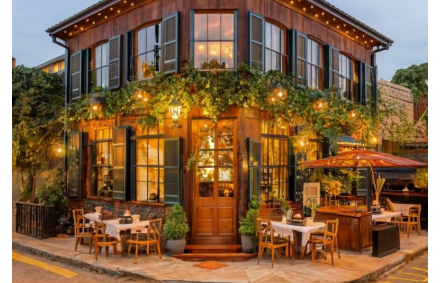
However, the unwillingness to scale has a captivating quality. Down Home seems like a counterargument in a field that is fixated on growth and Instagram reach. It implies that a restaurant can thrive by remaining modest, anchored, and incredibly local.
This idea is reflected in the dining room itself. When the weather permits, sit outside. a fireplace that, on chilly nights, takes center stage. Simple linens, wooden tables, and deliberate minimalism that lets the food and surroundings speak for themselves are examples of decor that doesn’t push too hard. Nothing feels carefully chosen for the camera, but you get the impression that every aspect has been taken into account.
There isn’t a clear gastronomic attraction in Grey County. It is more well-known for its apple orchards and ski hills than for its great restaurants. However, that’s part of the appeal of Down Home. It’s not an attempt to bring metropolitan trends or coastal sophistication to rural Ontario. It is arguing that this landscape—these fields, these farmers, these seasons—deserves the same consideration and skill that any top-tier eatery would provide.
Reservations are necessary, and they fill up fast. Given the context, the OpenTable and Tock booking system feels almost laughably contemporary. However, it is effective. Visitors organize their nights around a single meal, make commitments weeks in advance, and spend hours traveling through rural areas.
But all of this is clouded by a question. Does a purposefully tiny model really make a difference? Can a single farmhouse restaurant change people’s opinions about Ontario wine, local cuisine, or what’s feasible outside of big cities? It’s difficult to say. However, it’s difficult to avoid feeling as though something is changing when you see guests departing more slowly than they arrived, speaking in hushed tones, and sharing tidbits about what they just ate.
Down Home does not promise to be the restaurant of the future. It’s too specific for that, too connected to this precise area of the countryside and this specific community of farmers and foragers. However, it does imply that there is still space for eateries that don’t compromise on location. that remain grounded. One ten-course dinner at a time, they feel their tale is worth sharing.
